
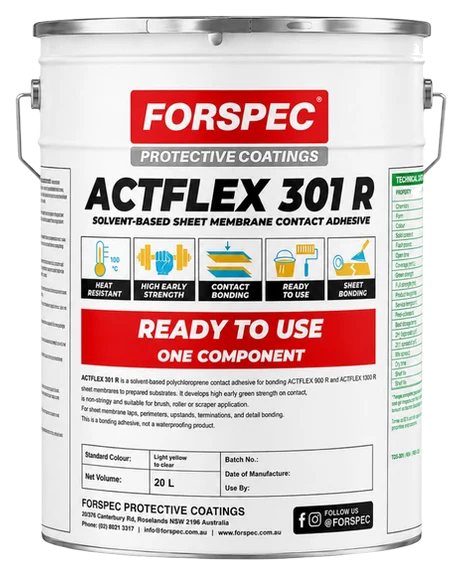
ACTFLEX 301 R Contact adhesive
Solvent-based polychloroprene contact adhesive for sheet membrane bonding
Contact adhesive that holds sheet membrane the moment the faces meet and stays bonded to 100°C.
ACTFLEX 301 R coverage, coats and cure times
Solvent-based polychloroprene contact adhesive for bonding ACTFLEX 1300R and ACTFLEX 900R butyl rubber sheet membranes to prepared substrates. One component, ready to use, by brush, roller or scraper.
- Coverage
- 4–6 m²/Ltypicalper coated face; 2–3 m² per litre with both faces coated · TDS p3
- Both faces
- 0.33–0.50 L/m²typicalconsumption per m² of bonded area · TDS p3
- 4 L pack
- 7–10 m²typicalpractical bonded area, 10% wastage allowed · TDS p3
- 20 L pack
- 36–54 m²typicalpractical bonded area, 10% wastage allowed · TDS p3
- Tack dry
- ≈ 7–12 mintypicalready to join, at 25°C and 50% RH · TDS p4
- Open time
- ≈ 30 mintypicalmaximum before joining · TDS p4
- Full bond
- 24 htypicalprotect from movement until then · TDS p4
- Bond pressure
- Min 276 kPa40 psi, by roller or press · TDS p2
- Service temp
- -40 to +100°Ctypicalonce bonded · TDS p2
From the FORSPEC data sheet, TDS-301R · Revision 1 · 12 November 2026. Times are at 25°C and 50% relative humidity unless the data sheet says otherwise. Typical = FORSPEC’s own typical value, not a laboratory-certified one.
Where ACTFLEX 301 R is used
Use it for
- Bonding ACTFLEX 1300R butyl rubber sheet membrane to prepared bases
- Bonding ACTFLEX 900R butyl rubber sheet in well-ventilated areas
- Sheet laps, perimeters, upstands and terminations that are not welded
- Concrete, masonry, render, screed, fibre cement and timber-based bases
- Changes of plane and penetrations where the sheet must hold at once
Know before you start
- Not a waterproofing product. Not for tanks, ponds, pools or standing water
- Not for PVC, TPO, polyethylene or polypropylene sheet, copper, or expanded polystyrene
- Highly flammable wet: not for confined or unventilated spaces or near ignition sources
- Will not bond to a damp surface, and never goes in a lap that will be heat-welded
How to apply ACTFLEX 301 R
- 01
Prepare
Clean, dry, sound surface free of oil, grease, dust, laitance and curing compounds. Concrete at least 28 days old. Vacuum all dust. Prepare both faces before any adhesive goes on.
- 02
Check moisture
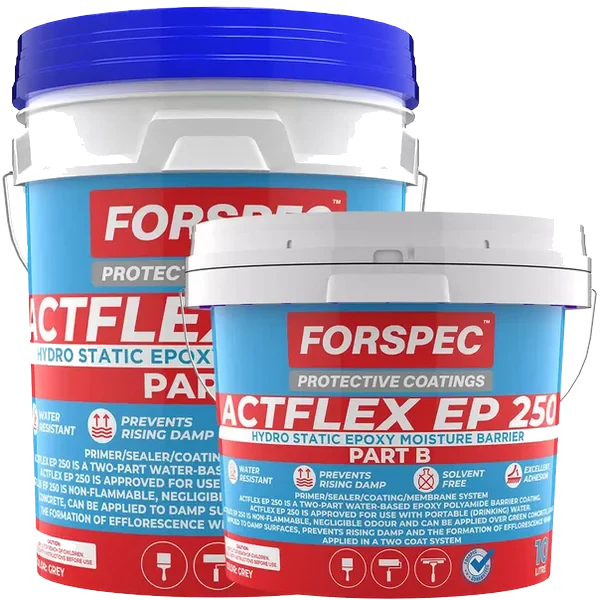
At 4.5% substrate moisture or below, bond directly, or prime where the sheet membrane TDS requires it. Above 4.5%, prime with two coats of ACTFLEX EP250 and let it fully cure first.
- 03
Stir
Ready to use. Stir with a flat paddle at low speed, without whipping in air. Do not thin or dilute. Reseal the container straight after decanting.
- 04
Coat
Brush, roller or scraper an even thin coat on BOTH faces. Let both go touch dry, about 7 to 12 minutes. Knuckle test: tacky, but nothing left on the skin.
- 05
Join
Join within about 30 minutes. Align the sheet first, it cannot be moved once the faces meet. If the open time is exceeded, put a fresh thin coat on one face and let it tack up again.
- 06
Roll
Roll the whole area to at least 276 kPa (40 psi), centre outwards. Roll laps, perimeters, upstands and terminations a second time. Protect from movement for 24 hours.
A short guide from the data sheet. Read the full ACTFLEX 301 R TDS before you start.
ACTFLEX 301 R test reports and compliance
- Water resistance
- Good; not for continuous immersionManufacturer test data, typical (FORSPEC R&D to ASTM D896)
- Oil and petrol resistance
- Good short-term resistance; not for prolonged immersionManufacturer test data, typical (FORSPEC R&D to ASTM D896)
- Service temperature, bonded
- -40°C to +100°C; continuous service to 100°CManufacturer test data, typical (FORSPEC R&D, bonded specimens held at temperature)
- Solids content
- Approx. 20%Manufacturer test data, typical (FORSPEC R&D to EN 827)
Results as stated in the data sheet, TDS-301R · Revision 1 · 12 November 2026. Warranty up to 25 years, depending on the system: ask FORSPEC which term applies to your system.
ACTFLEX 301 R questions
What does ACTFLEX 301 R bond?
It bonds ACTFLEX 1300R and ACTFLEX 900R butyl rubber sheet membranes to prepared substrates, including laps, perimeters, upstands and terminations that will not be heat-welded.
Do I coat both sides?
Yes. It is a contact adhesive, so coat both faces and let both tack up. The sheet allows one face only where a surface is confirmed porous, bonded straight away. Where there is any doubt, coat both faces.
How much do I need?
One litre covers 4–6 m² of a single face, so 2–3 m² of bonded area with both faces coated. In practice a 4 L pack bonds 7–10 m² and a 20 L pack 36–54 m², with 10% allowed for wastage. Typical values.
How long do I wait before joining?
About 7 to 12 minutes at 25°C and 50% RH, until both faces are touch dry. Join within about 30 minutes. Heat and air movement shorten both times, so check on a trial area.
Can it go on a damp slab?
No. It will not bond to a damp substrate. Bond directly only where substrate moisture is 4.5% or below. Above 4.5%, prime with two coats of ACTFLEX EP250 and let it fully cure before the adhesive.
How hot can the bond get?
Once bonded the service range is -40°C to +100°C, with continuous service to 100°C. Typical FORSPEC R&D values.
Used with ACTFLEX 301 R
ACTFLEX 301 R TDS and SDS
Always work from the current data sheet. Every FORSPEC TDS and SDS →
Specify it. Or buy it.
Send the drawings or photos and FORSPEC comes back with the system, the details and the quantities. Or find a FORSPEC stockist for ACTFLEX 301 R.