
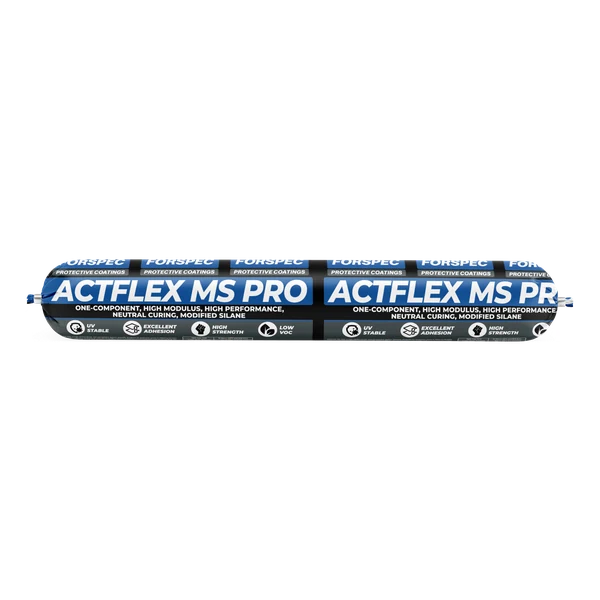
ACTFLEX MS PRO Joint sealant
One-component modified silane polymer joint sealant
Primerless, non-staining MS polymer sealant for joints and membrane cove fillets. Tack-free in 15 minutes.
ACTFLEX MS PRO coverage, coats and cure times
One-component silane polymer sealant for movement joints, junctions and penetrations, supplied in 600 mL sausages. It also forms the cove fillet inside FORSPEC waterproofing systems.
- Tack-free
- 15 mintool the bead within this time · TDS p2
- Cure rate
- 2.0 mm/daya 10 mm bead fully cured in approximately 5 days · TDS p2
- Joint width
- 5–35 mmdesign moving joints at width-to-depth 2:1 · TDS p4
- Movement
- ± 25%typicalISO 11600 F Class 25 LM, manufacturer classification · TDS p2
- Cove fillet
- 15 x 15 mmexternal applications; about 24 h to cure before membrane · TDS p4
- Fillet yield
- ≈ 5.3 mof 15 x 15 mm fillet per 600 mL sausage · TDS p5
- Joint yield
- 6.0 mper sausage at 10 mm x 10 mm, before wastage · TDS p5
- Apply at
- 5–35°Cambient and substrate · TDS p2
- Service temp
- -10 to +65°Conce fully cured · TDS p2
From the FORSPEC data sheet, TDS-MSPRO · Revision 2 · 26 August 2026. Times are at 25°C and 50% relative humidity unless the data sheet says otherwise. Typical = FORSPEC’s own typical value, not a laboratory-certified one.
Where ACTFLEX MS PRO is used
Use it for
- Construction, expansion and control joints in concrete and masonry
- Perimeter and change-of-plane junctions, internal corners
- Cove fillets within FORSPEC membrane systems
- Penetrations, pipe collars and floor waste perimeters
- Joints to metal, glass, ceramic tile, GRP and fibre cement
- Movement joints in tiling, where not subject to immersion
Know before you start
- Not for trafficked floor joints, point loading, wheeled traffic or abrasion
- Not for permanent hydrostatic pressure or permanently immersed joints
- Not for polyethylene, polypropylene, polycarbonate or bituminous surfaces
- Not for structural glazing or painted timber
How to apply ACTFLEX MS PRO
- 01
Prepare
Joint faces sound, clean, dry and free of oil, wax, curing compounds, laitance, paint and efflorescence. Mask both arrises where a clean line matters.
- 02
Prime
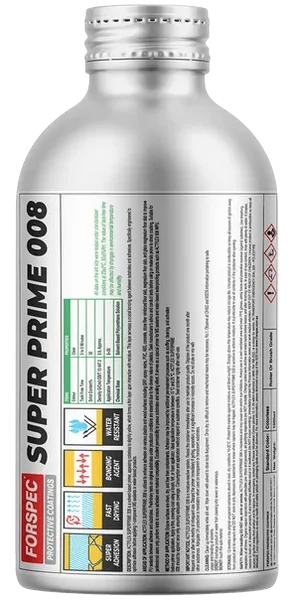
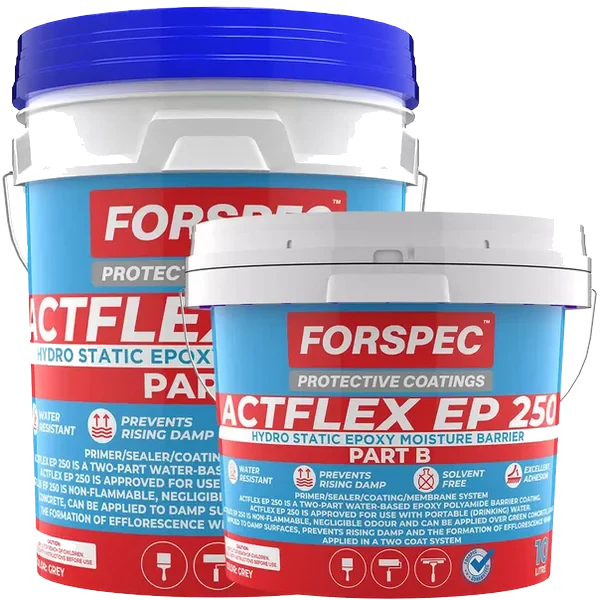
Primerless on most sound, clean, dry surfaces. Internal dry or non-porous: ACTFLEX SUPERPRIME 008. External or moisture-carrying: ACTFLEX EP250. Seal within 24 hours of primer touch dry.
- 03
Backing rod
Fit closed-cell rod about 25% oversize after priming, or bond-breaker tape. Minimum sealant depth 5 mm. Never allow three-sided adhesion.
- 04
Gun
Trim the nozzle at 45°, slightly under the joint width. Extrude steadily, nozzle ahead of the bead, in full contact with both faces and no air.
- 05
Tool
Tool within 15 minutes to a concave profile with a dry tool or clean water. Never detergent, soap or solvent. Pull masking tape off straight after.
- 06
Cove fillet
In FORSPEC systems, tool a 15 mm x 15 mm cove for external work. Let it cure, typically 24 hours, then take the membrane 50 mm onto each plane.
A short guide from the data sheet. Read the full ACTFLEX MS PRO TDS before you start.
Drawings for the systems it goes in
FORSPEC standard details as PDF and DXF. Each sheet is a generic detail: the specification names the products.
ACTFLEX MS PRO test reports and compliance
- ISO 11600 classification
- F Class 25 LMManufacturer classification, verification testing programmed
- VOC content, ASTM D3960
- 16 g/LFORAY Laboratories (NATA 1231) Certificate P26050125
- GBCA Green Star
- Meets limit of 50 g/LDesign & As Built V1.3-13.1.1B, Interiors V1.3-12.1.1B
Download the reports
Results as stated in the data sheet, TDS-MSPRO · Revision 2 · 26 August 2026. Warranty up to 25 years, depending on the system: ask FORSPEC which term applies to your system.
ACTFLEX MS PRO questions
How far does a 600 mL sausage go?
Width x depth in mm gives the cross-section: a 10 mm x 10 mm joint gives 6.0 m, 10 mm x 5 mm gives 12.0 m, 20 mm x 10 mm gives 3.0 m. Allow 10–15% for wastage and tooling.
Do I need a primer with ACTFLEX MS PRO?
Not on most sound, clean, dry surfaces. Where priming applies, use ACTFLEX SUPERPRIME 008 internally and on non-porous surfaces, or ACTFLEX EP250 externally or where substrates carry moisture.
How wide can the joint be?
5 to 35 mm wide, at a width-to-depth ratio of 2:1. Minimum depth is 5 mm, and 8 mm against masonry and other porous faces. Set the width so movement stays within ±25%.
Can I paint over it?
Yes, with water-based or multi-component coatings once fully cured. Coating a moving joint reduces its movement accommodation, so trial the coating first and never coat a joint working near its limit.
How long before I apply the membrane over a fillet?
Typically 24 hours for a 15 mm fillet. The fillet must have skinned and developed strength, and the primer must be fully cured under it. Take the membrane 50 mm onto each plane.
What is it not for?
Trafficked floor joints, permanently immersed joints, structural glazing, painted timber, and polyethylene, polypropylene, polycarbonate or bituminous surfaces. Do not thin it.
Used with ACTFLEX MS PRO
ACTFLEX MS PRO TDS and SDS
Always work from the current data sheet. Every FORSPEC TDS and SDS →
Specify it. Or buy it.
Send the drawings or photos and FORSPEC comes back with the system, the details and the quantities. Or find a FORSPEC stockist for ACTFLEX MS PRO.