
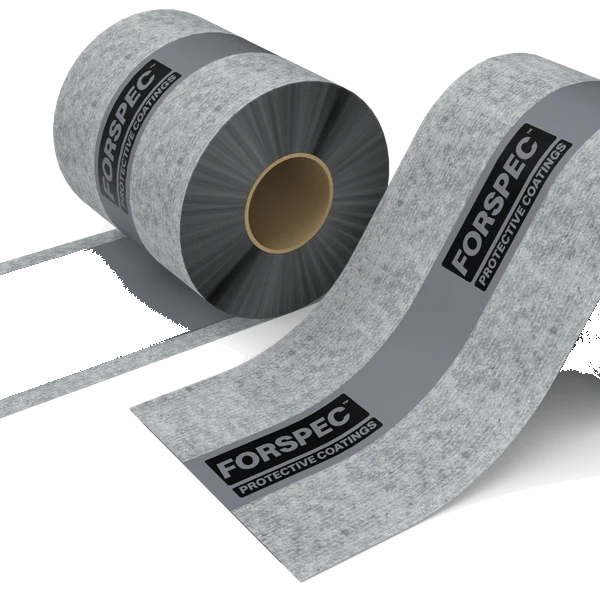
EXPANDOFLEX FT JOINT TAPE Felt-faced joint tape
Felt-laminated TPE expansion joint tape for structural and movement joints
Felt-faced expansion joint tape. The membrane bonds into the felt, so there is no cold joint at the tape.
EXPANDOFLEX FT JOINT TAPE coverage, coats and cure times
Felt-laminated TPE tape for primary and transverse movement joints, floor-to-wall upturns and podium, tunnel and planter joints. The membrane keys into the polyester felt on both edges.
- Service temp
- −30 to +80°Ctypicalmanufacturer value, pending testing · TDS p2
- Apply at
- 5–35°Cambient and substrate · TDS p2
- Epoxy width
- Min 40 mmper face, matched to the flange (typically 40 or 50 mm) · TDS p2
- Epoxy layer
- 1.0–1.5 mmbedding and capping, PROBOND 1100 · TDS p2
- Working time
- 30–40 minPROBOND 1100 at 20°C, shorter as it warms · TDS p3
- Cure
- 24–48 hat 20°C before movement or membrane · TDS p2
- Tape overlap
- Min 50 mmnon-felt undersides bonded with PROBOND 1100 · TDS p3
- Membrane lap
- Min 100 mmbeyond each edge of the tape · TDS p4
- Epoxy use
- ≈ 0.25 L/m40 mm flange at 1.25 mm; about 0.31 L/m at 50 mm · TDS p4
From the FORSPEC data sheet, TDS-EXPANDOFLEXFT · Revision 1 · 26 August 2026. Times are at 25°C and 50% relative humidity unless the data sheet says otherwise. Typical = FORSPEC’s own typical value, not a laboratory-certified one.
Where EXPANDOFLEX FT JOINT TAPE is used
Use it for
- Primary (PMJ) and transverse (TMJ) movement joints
- Structural movement joints above and below ground
- Base-to-wall transitions and floor-to-wall upturns
- Tunnel, retaining wall and podium slab joints
- Planter and green roof joints needing root resistance
- Joints that tie into a liquid-applied or sheet membrane
Know before you start
- Epoxy on the underside only: never on the felt face or the centre zone
- Not load bearing and not an expansion joint coverplate
- Do not coat the central movement zone with membrane
- Not below 5°C or above 35°C, and not a fix for an undersized joint
How to apply EXPANDOFLEX FT JOINT TAPE
- 01
Prepare
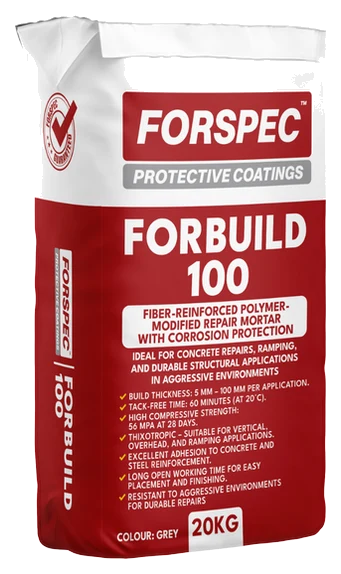
Diamond grind or shot blast to dry, sound concrete free of dust, curing agents and sealers. Mark the joint centreline. Repair damaged arrises with FORBUILD 100 or FORCRETE 100.
- 02
Cut and join
Pre-cut with sharp shears, keeping the felt intact. Join with a 50 mm overlap bonded on the non-felt undersides with PROBOND 1100, or heat-weld with a hot air gun. Never epoxy felt to felt. No open flame.
- 03
Mix epoxy
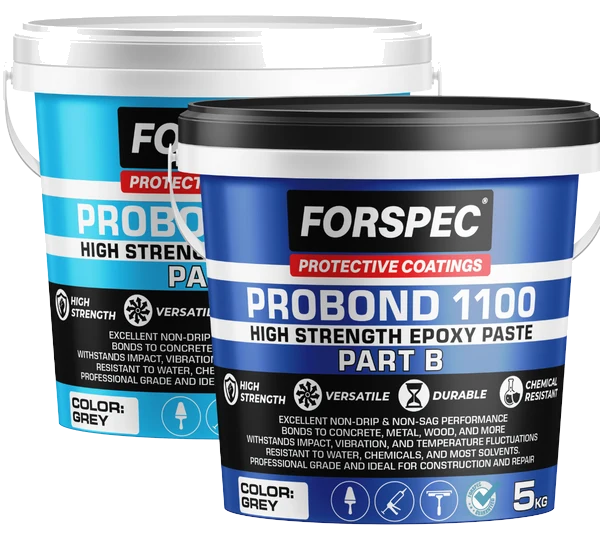
Mix PROBOND 1100 Part A and B at low speed until uniform. Working time is 30–40 minutes at 20°C. Do not dilute or re-mix epoxy that has started to cure.
- 04
Bed
Trowel 1.0–1.5 mm onto each side, 40 or 50 mm wide to match the flange. Press only the elastomeric underside into the wet epoxy, then roll the flanges. Keep epoxy off the felt.
- 05
Cap and cure
Cap the flanges at 1.0–1.5 mm, 20 mm past the tape edge. Leave undisturbed for 24–48 hours at 20°C, with the centre zone free of epoxy.
- 06
Membrane
Apply the membrane directly onto the felt, carrying it at least 100 mm past each tape edge. Never coat over the central movement zone.
A short guide from the data sheet. Read the full EXPANDOFLEX FT JOINT TAPE TDS before you start.
Where it has been used
FORSPEC projects built with EXPANDOFLEX FT JOINT TAPE.
EXPANDOFLEX FT JOINT TAPE questions
What is different about the FT tape?
It has polyester felt bonded to both edges, so the membrane bonds into the tape rather than onto it. That gives a continuous waterproofed transition with no cold joint between tape and membrane.
Which membranes can go over it?
The TDS lists polyurethane, polyurea, bitumen-based and acrylic waterproofing systems. Apply the membrane after the epoxy has cured 24–48 hours.
Where does the epoxy go?
Only on the elastomeric underside, 1.0–1.5 mm thick. Never on the felt face, and never across the central movement zone.
How much epoxy do I need?
About 0.25 L per linear metre at a 40 mm flange and 1.25 mm average thickness, or about 0.31 L at a 50 mm flange. Confirm against the PROBOND 1100 TDS and allow 10–15% for wastage.
What about high-movement joints?
Form a downturn loop into the joint void and bond the side flanges only. The structural engineer must confirm the movement allowance and deflection dimensions first.
Used with EXPANDOFLEX FT JOINT TAPE
EXPANDOFLEX FT JOINT TAPE TDS and SDS
Always work from the current data sheet. Every FORSPEC TDS and SDS →
Specify it. Or buy it.
Send the drawings or photos and FORSPEC comes back with the system, the details and the quantities. Or find a FORSPEC stockist for EXPANDOFLEX FT JOINT TAPE.