
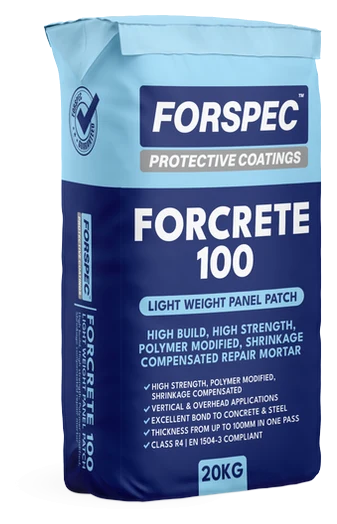
FORCRETE 100 Repair mortar
High-build, high-strength, shrinkage-compensated structural repair mortar
High-build repair mortar, 3 to 100 mm in one pass, about 70 MPa at 28 days.
FORCRETE 100 coverage, coats and cure times
Fibre-reinforced, polymer-modified, shrinkage-compensated structural repair mortar for columns, beams, walls and soffits. It places 3 to 100 mm in a single pass, vertical, overhead and horizontal, without formwork.
- Compressive
- ~70 MPatypicalat 28 days; ~25 at 1 day, ~51 at 7 days · TDS p2
- Thickness
- 3–100 mmper pass, in any orientation · TDS p2
- Water
- 3.6 Lper 20 kg bag · TDS p2
- Pot life
- 30–40 mintypicalat 25°C and 50% RH · TDS p2
- Set
- ~1.5 / ~2.5 htypicalinitial / final set · TDS p2
- Bond
- > 2.0 MPatypicalto concrete, EN 1542 · TDS p2
- Freeze-thaw
- 300 cyclestypicalpass, ASTM C666 · TDS p2
- Coverage
- ≈ 1.1 m²per 20 kg bag at 10 mm; about 1.8 kg/m² per mm · TDS p3
- Cure
- 72 h minimumCURESEAL or damp hessian and plastic · TDS p4
From the FORSPEC data sheet, TDS-FORCRETE100 · Revision 2 · 12 August 2026. Times are at 25°C and 50% relative humidity unless the data sheet says otherwise. Typical = FORSPEC’s own typical value, not a laboratory-certified one.
Where FORCRETE 100 is used
Use it for
- Spalled or damaged concrete on columns, beams, walls and soffits
- Patching and reinstatement around corroded reinforcement
- Bridge decks, tunnels, marine and water-exposed structures
- Precast element defect repair and structural reinstatement
- Structures exposed to impact, abrasion or environmental deterioration
Know before you start
- Not for unstable or moving substrates: reflective cracking will occur
- Not for new concrete under 28 days old
- Never exceed 3.6 L of water per bag, and never re-temper stiffened mortar
- Do not apply below 5°C and falling, above 35°C, or onto frozen substrates
Its FORSPEC systems
How to apply FORCRETE 100
- 01
Prepare
Remove all unsound concrete, saw-cut edges square at least 5 mm deep and profile to CSP 4–6. Bring to saturated surface dry with no standing water. Clean steel to bright metal and prime it.
- 02
Prime
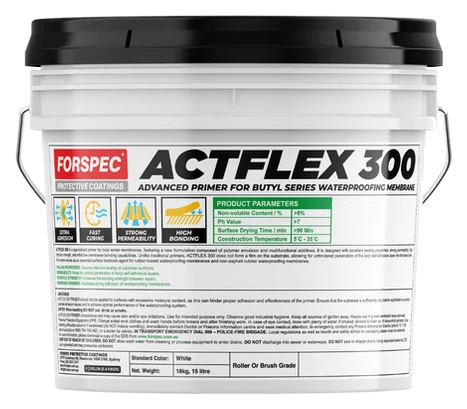
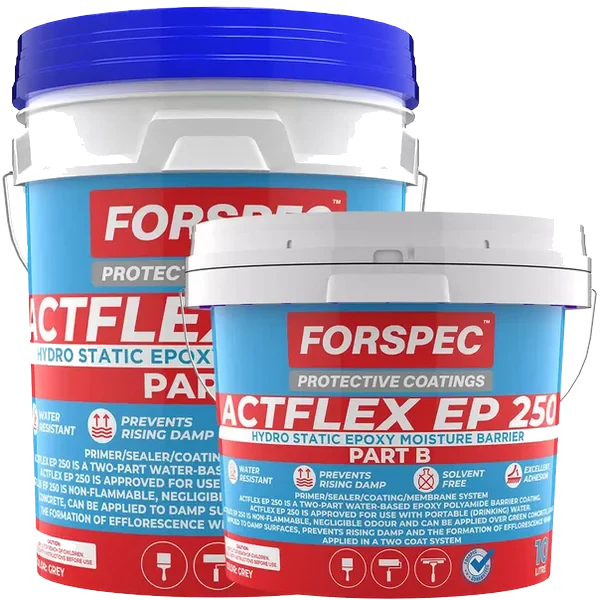
ACTFLEX 300 on prepared concrete, or ACTFLEX EP250 for damp, porous or immersed conditions. Place the mortar while the primer is tacky, and re-prime if it dries.
- 03
Mix
Mechanical mixing only, 400–600 rpm. Put 3.6 L clean water per 20 kg bag in first, add powder gradually, mix 3 to 5 minutes, pause 1 minute, re-mix 30 seconds. Use within 30 to 40 minutes.
- 04
Apply
Trowel or low-pressure wet-spray from the base upward, pressing around bars to remove voids. 3 to 100 mm per pass. Build deeper repairs in layers, scarifying each layer once stiff.
- 05
Finish
At initial set, finish with a steel float for a smooth face or a sponge float for texture. Do not wet the surface or overwork it.
- 06
Cure
Cure straight away with ACTFLEX CURESEAL or damp hessian and plastic for at least 72 hours. Keep it from drying, rain, hose water and traffic for the first 24 hours.
A short guide from the data sheet. Read the full FORCRETE 100 TDS before you start.
Drawings for the systems it goes in
FORSPEC standard details as PDF and DXF. Each sheet is a generic detail: the specification names the products.
FORCRETE 100 test reports and compliance
- EN 12190 compressive
- ~70 MPa at 28 days (R4 threshold 45 MPa or more)Forspec R&D typical; EN 1504-3 classification testing on request
- EN 1542 adhesion
- Greater than 2.0 MPa (R4 threshold 2.0 MPa or more)Forspec R&D typical
- EN 13412 modulus
- ~26 GPa (R4 threshold 20 GPa or more)Forspec R&D typical
- EN 1015-11 flexural
- ~10 MPa at 28 daysForspec R&D typical
- ASTM C666 freeze-thaw
- Pass, 300 cyclesForspec R&D typical
Results as stated in the data sheet, TDS-FORCRETE100 · Revision 2 · 12 August 2026. Warranty up to 25 years, depending on the system: ask FORSPEC which term applies to your system.
FORCRETE 100 questions
How much FORCRETE 100 do I need?
About 1.8 kg per m² per mm of thickness. A 25 mm repair over 1 m² needs about 45 kg, around two and a quarter 20 kg bags. One bag mixed with 3.6 L of water makes about 11.2 litres.
Do I need a primer?
Yes. Use ACTFLEX 300 for general use, or ACTFLEX EP250 for damp, porous or immersed exposure. Place the mortar while the primer is tacky.
How thick can I place it in one go?
3 to 100 mm per pass, vertical, overhead or horizontal, without formwork. Repairs deeper than 100 mm are built in successive layers.
Can I spray it?
Yes, with low-pressure wet-spray equipment with a variable-output rotor/stator and a compressor of at least 3–5 bar. Use a 10–14 mm nozzle at 30–50 cm and trowel-finish each layer.
How do I cure it?
Use ACTFLEX CURESEAL or damp hessian and plastic for a minimum of 72 hours. Do not let it dry, or take rain, hose water or traffic, in the first 24 hours.
Is there an enhanced mix?
Yes. Replace the water with a 2:1 blend of clean water and ACTFLEX 300, which is 2.4 L water plus 1.2 L ACTFLEX 300 per bag, for better bonding and moisture tolerance.
Used with FORCRETE 100
FORCRETE 100 TDS and SDS
Always work from the current data sheet. Every FORSPEC TDS and SDS →
Specify it. Or buy it.
Send the drawings or photos and FORSPEC comes back with the system, the details and the quantities. Or find a FORSPEC stockist for FORCRETE 100.