
AS 3740 in plain English. Seven rules that get missed.
·2 min read·FORSPEC Technical Team
The short version
- AS 3740:2021 is the wet-area standard the NCC calls up. Building to it does not switch off the NCC's own rules on falls and where waterproofing goes.
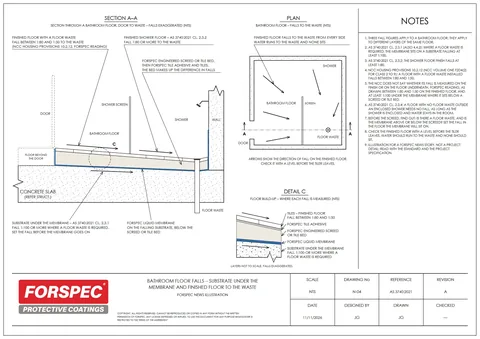
- A floor with a floor waste falls between 1:80 and 1:50 under the NCC. Shower walls are waterproof to at least 1800 mm.
- A tile trim at the door is not a waterstop.
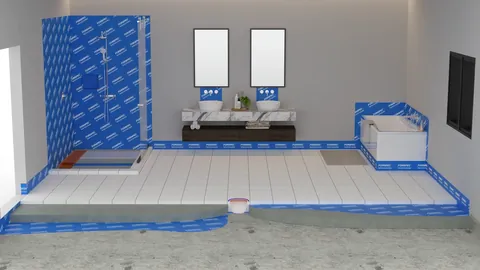
AS 3740 covers waterproofing of wet areas in homes and apartments. NCC 2022 and NCC 2025 both call up the 2021 edition, and NCC 2025 did not change the wet-area rules in substance. So these seven points apply on every bathroom being built today.
1. Falls
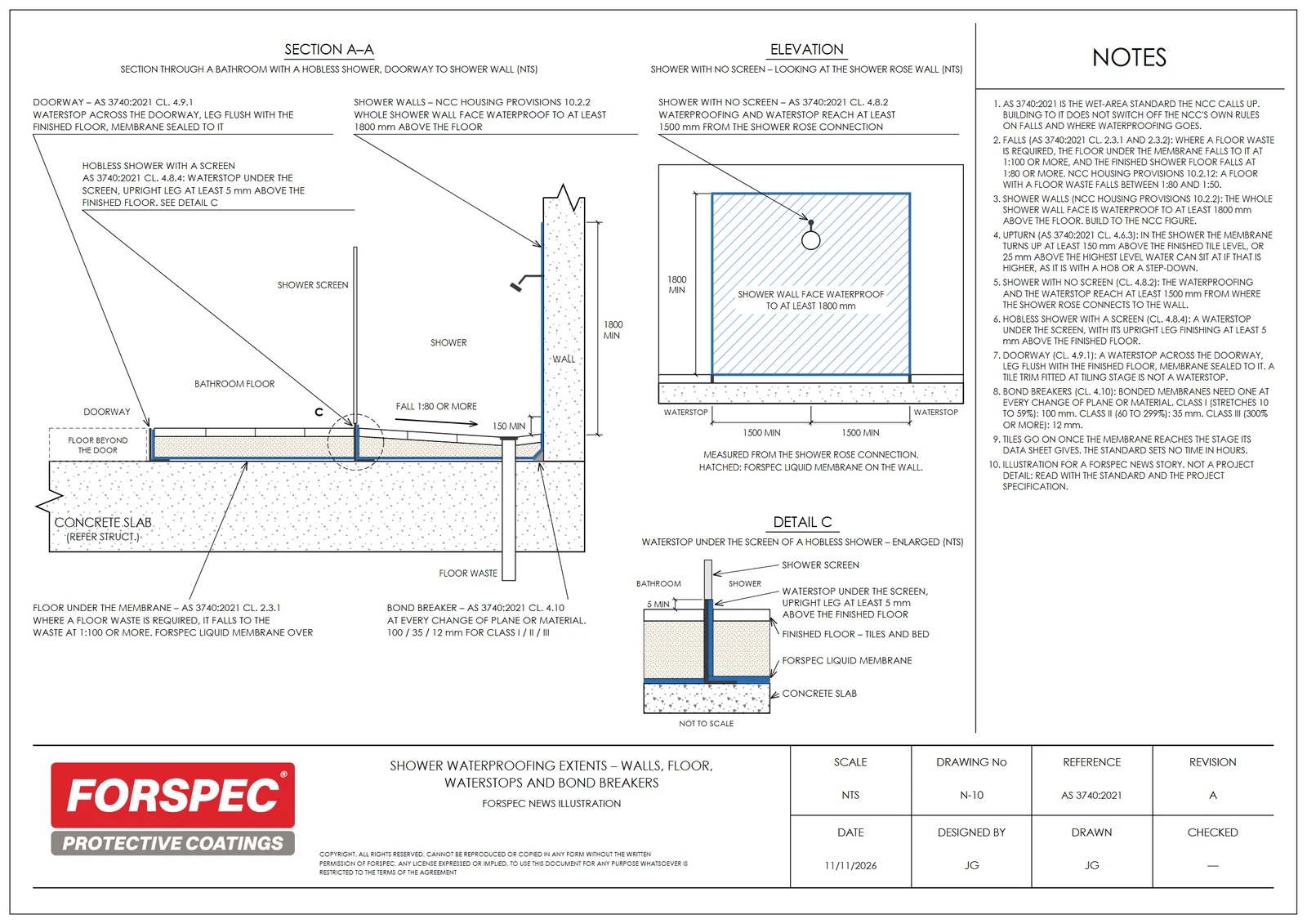
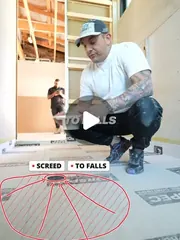
Where a floor waste is required, the floor under the membrane falls to it at 1:100 or more, and the finished shower floor falls at 1:80 or more. The NCC is stricter for any floor that has a floor waste: the fall is between 1:80 and 1:50.
2. Shower walls
On its own, AS 3740 asks for waterproof junctions and water-resistant wall faces. The NCC asks for more: the whole shower wall face is waterproof to at least 1800 mm above the floor. Build to the NCC figure.
3. The upturn
In the shower the membrane turns up at least 150 mm above the finished tile level, or 25 mm above the highest level water can sit at if that is higher, as it is with a hob or a step-down.
4. Showers with no screen
For an unenclosed shower, the waterproofing and the waterstop reach at least 1500 mm from where the shower rose connects to the wall.
5. Hobless showers
A level-entry shower with a screen needs a waterstop under the screen, with its upright leg finishing at least 5 mm above the finished floor.
6. The door
A waterstop runs across the doorway with its leg finishing flush with the finished floor, and the membrane is sealed to it. A tile trim fitted at tiling stage is not a waterstop. Regulators in the ACT and WA have both reported this as a common finding.
7. Bond breakers
Bonded membranes need a bond breaker at every change of plane or material. Its width depends on how far the membrane can stretch:
- Class I (stretches 10 to 59%)
- 100 mm bond breaker
- Class II (60 to 299%)
- 35 mm
- Class III (300% or more)
- 12 mm
The details for each of these are in the drawings library: shower waterstop angle, door waterstop angle, shower hob, tap penetration and more.
The drawing
Where this comes from
- AS 3740:2021: 2.3.1, 2.3.2, 4.6.3, 4.8.2, 4.8.4, 4.9.1, 4.10, 4.5.2
- NCC Housing Provisions: 10.2.12, 10.2.2
- AS/NZS 4858:2004: 5
- ACTFLEX 989 CWP Technical Data Sheet, Revision 3 (Class III)
Standards are summarised in FORSPEC's own words as a guide. Read the standard itself and your project documents before you build.
Systems, products and drawings
Got a job this applies to?
Send the drawings or a few photos. FORSPEC comes back with the system, the details and the products for your job, within 6 business hours.
On site with FORSPEC
@forspec.pc on Instagram →
 ▶ 3.2K
More news
All news →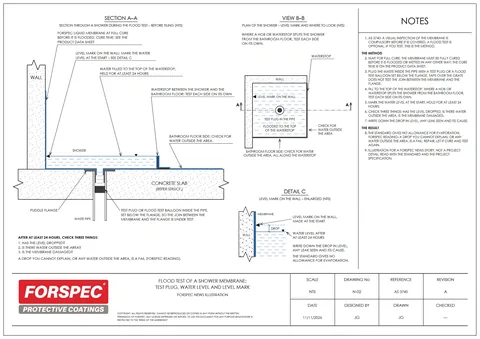
The month in waterproofing. In one email.
Code and standards changes, new products, new test reports and jobs from site. Once a month. No sales emails.