
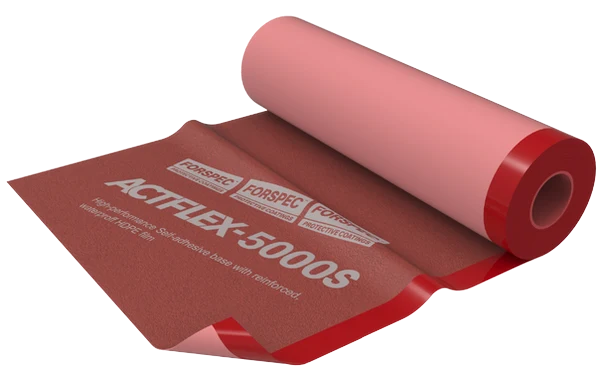
ACTFLEX 5000S Pre-applied sheet
Pre-applied self-adhesive butyl rubber membrane with reactive sand bonding layer
Pre-applied butyl sheet that fuses to the concrete topping poured onto it.
ACTFLEX 5000S sizes and key figures
Self-adhesive butyl rubber sheet for basement walls and floors, lift pits, tunnels and podium slabs. Its reactive sand top layer bonds to fresh concrete or heated mortar on contact.
- Topping bond
- ≈ 1.0–1.5 MPatypicalshear capacity, reactive sand to topping slab · TDS p2
- Impermeability
- 0.6 MPatypicalimpermeable for 120 minutes, GB/T 23457 · TDS p2
- Between layers
- 0.8 MPatypical120 min across a 35 mm hydraulic gradient · TDS p2
- Tensile strength
- ≥ 600 N/50 mmtypicalGB/T 23457, FORSPEC R&D result · TDS p2
- Elongation
- ≥ 150%typicalat break, GB/T 23457 · TDS p2
- Low temperature
- −25°Ctypicalflexible, no cracking · TDS p2
- Heat resistance
- ≤ 2 mmtypicalslippage at 80°C for 2 hours · TDS p2
- Laps
- 75 mmtypicalside and end laps, rollered along the full length · TDS p2
- Bond forms
- On contactwith fresh concrete or heated mortar · TDS p4
From the FORSPEC data sheet, TDS-ACTFLEX5000S · Revision 2 · 9 November 2026. Times are at 25°C and 50% relative humidity unless the data sheet says otherwise. Typical = FORSPEC’s own typical value, not a laboratory-certified one.
Where ACTFLEX 5000S is used
Use it for
- Basement walls and floors
- Retaining walls and foundation walls
- Lift pits and below-ground tanks
- Tunnels, podium slabs and raft slabs
- Under concrete toppings and screeds needing chemical adhesion
- Pre-applied on substrates with minimal negative pressure
Know before you start
- Non-exposed only: cover with the topping slab, protection, backfill or finish
- Pre-applied only where negative pressure is minimal: confirm with the project engineer
- Never prime, coat or cover the sand face before the pour. Keep it clean and dry
- Not an exposed trafficable surface, and not a substitute for structural crack repair
How to apply ACTFLEX 5000S
- 01
Prepare
Concrete cured 28 days minimum, clean and free of laitance, oil and curing compounds, with no standing water or frost. Remove fins and sharp points. Form a smooth cove at internal corners.
- 02
Detail
Lay a separate 300 mm detail strip at every internal corner, floor-to-wall junction and penetration before the main sheet, and roller it into both planes.
- 03
Lay
Set out the sheet with the reactive sand face UPWARDS. Position it dry, peel the liner progressively and bed it from one edge, excluding air. Roll the whole area with a pressure roller.
- 04
Lap
Overlap all side and end laps by at least 75 mm and roller every lap firmly along its full length.
- 05
Protect
Keep the sand face clean and dry until the pour. Mud, ponded water or traffic stops the bond forming. Inspect every lap, corner and penetration and get pre-pour release.
- 06
Pour
Place the topping concrete or heated mortar directly onto the sand surface. The bond forms on contact. Full interface shear capacity comes once the topping reaches design strength.
A short guide from the data sheet. Read the full ACTFLEX 5000S TDS before you start.
Learn to install it
Hands-on FORSPEC training that covers ACTFLEX 5000S.
ACTFLEX 5000S test reports and compliance
- GB/T 23457
- Impermeability and hydraulic gradient resistance: FORSPEC R&D resultTypical value, not a certified result
- FORSPEC R&D
- Bond interface shear capacity to topping slab: in-house testTypical value, not a certified result
Results as stated in the data sheet, TDS-ACTFLEX5000S · Revision 2 · 9 November 2026. Warranty up to 25 years, depending on the system: ask FORSPEC which term applies to your system.
ACTFLEX 5000S questions
Which way up does ACTFLEX 5000S go?
Reactive sand face up, ready to receive the topping pour.
Can I prime or coat the sand face?
No. Do not prime, coat or cover it before the pour. Keep it clean and dry. Contamination, ponded water, mud or trafficking will stop the chemical bond forming.
How does the topping bond to it?
The reactive sand activates on contact with fresh concrete or heated mortar and forms a chemical bond. Shear capacity at the interface is approx. 1.0 to 1.5 MPa, a FORSPEC R&D figure.
Can I use it pre-applied on any wall?
Only on substrates with minimal negative pressure. Confirm the groundwater regime and negative head with the project engineer before specifying.
How much do I allow when ordering?
Take-off is the measured area plus upturns, plus 20% for laps and wastage. Lap allowance is approx. 10% and wastage approx. 10%. Add a 300 mm detail strip at every internal corner and penetration.
Does it need a torch or site adhesive?
No. It is self-adhesive butyl rubber, installed peel-and-stick on vertical and horizontal surfaces with no torching and no site adhesives.
Used with ACTFLEX 5000S
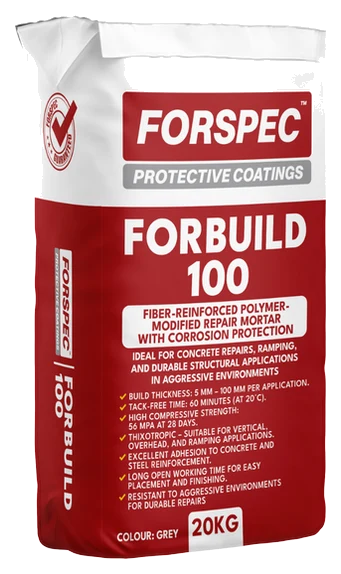
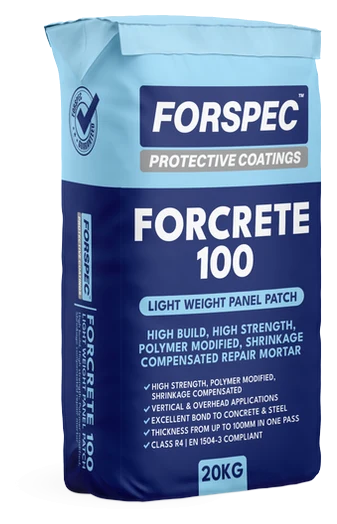
ACTFLEX 5000S TDS and SDS
Always work from the current data sheet. Every FORSPEC TDS and SDS →
Specify it. Or buy it.
Send the drawings or photos and FORSPEC comes back with the system, the details and the quantities. Or find a FORSPEC stockist for ACTFLEX 5000S.