
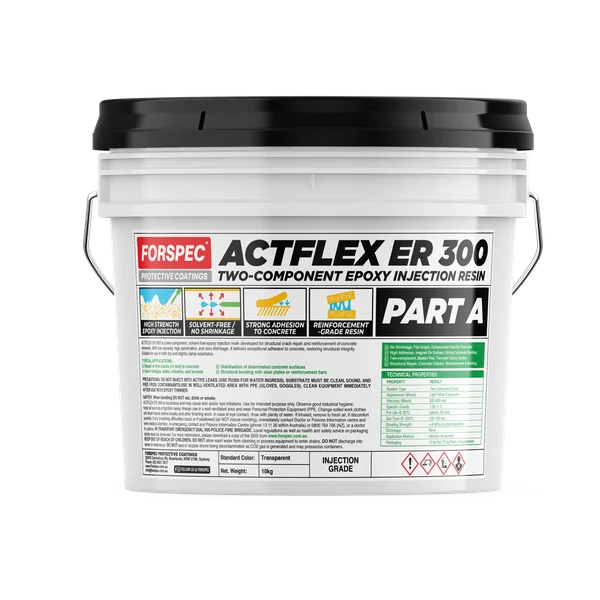
ACTFLEX ER300 Epoxy injection resin
Two-component low-viscosity structural epoxy injection resin
Low-viscosity epoxy injected under pressure to fill and bond cracks in reinforced concrete.
How ACTFLEX ER300 goes on
ACTFLEX ER300 mix, pressure and key figures
Two-component, solvent-free epoxy for cracks from 0.1 to 1.0 mm wide. It is machine-injected through packers, cures with no shrinkage and sets rigid.
- Crack width
- 0.1–1.0 mmfiner cracks: CRACKLOCK E400L · TDS p3
- Mix ratio
- 2 : 1resin to hardener by weight, metered by the machine · TDS p2
- Pack
- 15 kg setresin 10 kg + hardener 5 kg · TDS p2
- Pot life
- ≈ 35 mintypicalat 25°C, worked back from tests at 20°C · TDS p3
- Load after
- 18 htypicalcure before traffic or load, at 25°C · TDS p3
- Compressive
- > 80 MPatypicalASTM D695, manufacturer test data · TDS p2
- Packers
- 200–300 mmspacing along the crack, drilled at 45° to 60° · TDS p3
- Pressure
- Up to 2.5 MPastart at 0.5 to 1.0 MPa on hairline cracks · TDS p3
- Apply at
- 10–30°Cair and surface · TDS p3
From the FORSPEC data sheet, TDS-ER300 · Revision 1 · 25 August 2026. Times are at 25°C and 50% relative humidity unless the data sheet says otherwise. Typical = FORSPEC’s own typical value, not a laboratory-certified one.
Where ACTFLEX ER300 is used
Use it for
- Structural crack injection in reinforced concrete
- Cracks in slabs, beams and columns
- Re-bonding lifted concrete and floor toppings
- External steel plate bonding
- Industrial floors and warehouse slabs
- Precast, tilt-up and in-situ concrete
Know before you start
- Never into an active leak or a crack carrying running water
- Not for live or moving cracks: it cures rigid
- Never into a movement or expansion joint
- The repair design and load capacity are the project engineer's call
Its FORSPEC systems
How to apply ACTFLEX ER300
- 01
Inspect and mark
Confirm each crack is 0.1 to 1.0 mm wide and mark its run. Cracks that have moved, or are still moving, need an engineer first.
- 02
Clean
Clear dust, oil, coatings and debris with oil-free air or a vacuum. The crack must be dry or at most slightly damp.
- 03
Packers
Drill at 200 to 300 mm spacing, angled 45° to 60° to meet the crack at mid-depth. Blow out the dust and fix the packers tight.
- 04
Seal the surface
On wider cracks, or any crack that will not hold pressure, seal the crack line with PROBOND 1100 and let it cure fully.
- 05
Inject
Use the INJEXA SWDM 2500, which meters and mixes at the nozzle: do not premix. Start at the lowest packer at 0.5 to 1.0 MPa and never exceed 2.5 MPa.
- 06
Cure
Keep traffic and load off for 18 hours at 25°C. Flush the machine, hoses and nozzle straight after use.
A short guide from the data sheet. Read the full ACTFLEX ER300 TDS before you start.
How much ACTFLEX ER300 do I need?
Structural epoxy injection resin, 15 kg set
Demand per metre = crack width (mm) × depth (mm), in mL. A 15 kg set yields about 13.9 L, so a 0.5 × 250 mm crack needs 125 mL a metre, about 110 m a set, before any allowance. Real jobs take more: voids, branching, priming, mixer waste and flushing.
You need
0 sets
Where the figures come from
Demand per metre = crack width (mm) × depth (mm), in mL. A 15 kg set yields about 13.9 L, so a 0.5 × 250 mm crack needs 125 mL a metre, about 110 m a set, before any allowance. Real jobs take more: voids, branching, priming, mixer waste and flushing.
- Demand per linear metre: crack width (mm) × depth (mm) = mL per metre. TDS-ER300, R1, 25 Aug 2026, page 6
- Yield of a 15 kg set: about 13.9 L at a mixed density of 1.08 g/cm³. TDS-ER300, R1, 25 Aug 2026, page 6
- Crack width range; packer spacing: 0.1 to 1.0 mm; 200 to 300 mm along the crack. TDS-ER300, R1, 25 Aug 2026, page 3
Drawings for the systems it goes in
FORSPEC standard details as PDF and DXF. Each sheet is a generic detail: the specification names the products.
ACTFLEX ER300 test reports and compliance
- Compressive strength, ASTM D695
- Greater than 80 MPaManufacturer test data, typical
- Tensile strength, ASTM D638
- Greater than 25 MPaManufacturer test data, typical
- Flexural strength, ASTM D790
- Greater than 45 MPaManufacturer test data, typical
Results as stated in the data sheet, TDS-ER300 · Revision 1 · 25 August 2026. Warranty up to 25 years, depending on the system: ask FORSPEC which term applies to your system.
ACTFLEX ER300 questions
What crack widths is ACTFLEX ER300 for?
Cracks from 0.1 to 1.0 mm wide. For finer hairline cracks use CRACKLOCK E400L.
Can it be injected into a leaking crack?
No. Epoxy will not displace water and will not cure against it. Stop the flow with ACTFLEX HYDROPLUG, or use ACTFLEX PU200 where the crack itself carries water.
Do I mix Part A and Part B first?
Not with the INJEXA SWDM 2500. It is a dual-feed machine that meters and mixes the two parts at the nozzle, at 2 to 1 by weight. Pour 10 kg of resin and 5 kg of hardener into their own containers.
How long before the slab can be loaded?
18 hours at 25°C. Keep traffic and load off during the cure.
Will it take movement?
No. The cured resin is rigid and structural. Live and moving cracks must be assessed by an engineer and treated as movement joints, not injected.
What injection pressure should I use?
Start at 0.5 to 1.0 MPa for hairline cracks and raise it gradually for deeper or wider cracks, to a maximum of 2.5 MPa. More than that can widen the crack or cause a blowout.
Used with ACTFLEX ER300
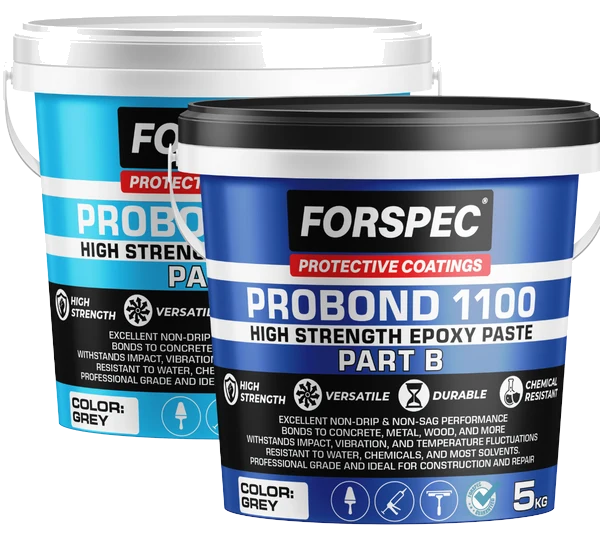
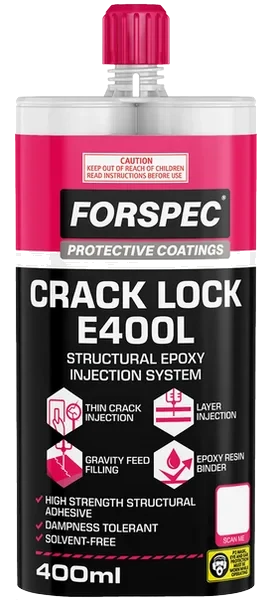
ACTFLEX ER300 data sheet
Always work from the current data sheet. Every FORSPEC TDS and SDS →
Specify it. Or buy it.
Send the drawings or photos and FORSPEC comes back with the system, the details and the quantities. Or find a FORSPEC stockist for ACTFLEX ER300.