
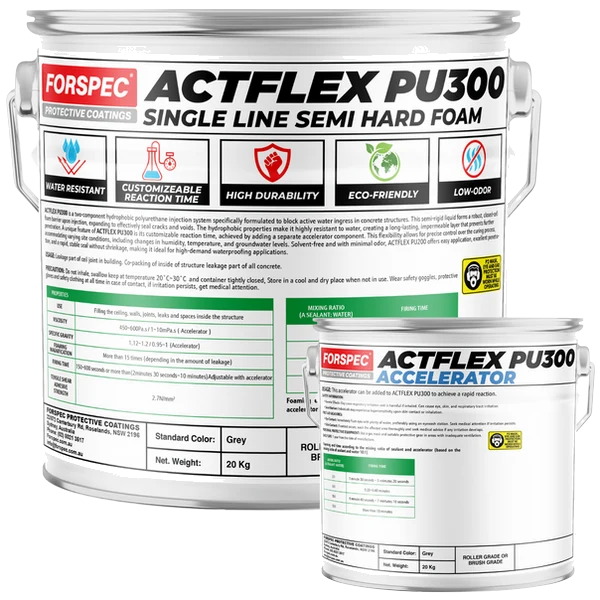
ACTFLEX PU300 PU injection resin
Two-component hydrophobic polyurethane injection resin
Hydrophobic PU resin with an accelerator you adjust to site conditions, for leaks and voids.
How ACTFLEX PU300 goes on
ACTFLEX PU300 sizes and key figures
Two-component hydrophobic polyurethane injection resin: base resin plus accelerator at 10:1 by weight. The accelerator dose sets the reaction time, so you can tune it to temperature and water flow.
- Mix ratio
- 10 : 1resin to accelerator by weight (standard) · TDS p2
- Pack
- 22 kg set20 kg resin + 2 kg accelerator · TDS p2
- Pot life
- 20–30 mintypicalonce mixed, at 25°C and 50% RH · TDS p2
- Foam expansion
- > 15×typicalfree foam · TDS p2
- Standard dose
- 340–360 stypicalreaction time at 10 : 1, 25°C · TDS p2
- Fast dose
- 150–200 stypicalreaction time at 2 : 1, 25°C · TDS p2
- Bond strength
- > 2.28 MPatypicalto concrete · TDS p2
- Full reaction
- 24 hourstypicalstable seal · TDS p4
- Apply at
- Above 10°Csubstrate and material · TDS p2
From the FORSPEC data sheet, TDS-PU300 · Revision 2 · 12 August 2026. Times are at 25°C and 50% relative humidity unless the data sheet says otherwise. Typical = FORSPEC’s own typical value, not a laboratory-certified one.
Where ACTFLEX PU300 is used
Use it for
- Sealing active leaks in concrete ceilings, walls, floors and joints
- Basements, tunnels, underground structures and retaining walls
- Filling voids, cracks and cavities in concrete (non-structural)
- Dams, reservoirs, wastewater structures and pipelines
- Voids behind structures, soil and rock, after geotechnical assessment
- Wet or dry conditions: dry cracks are pre-wetted through the packers
Know before you start
- Not a structural repair: use PROBOND 1100, CRACK PRO 1200PS or CRACKLOCK E400L
- Pot life is 20–30 minutes: mix only what you can inject in that time
- Not below 10°C, not UV stable, and not for live movement joints
- Not certified for drinking water (AS/NZS 4020) without written FORSPEC confirmation
How to apply ACTFLEX PU300
- 01
Mix
10:1 by weight, a full set being 20 kg resin and 2 kg accelerator, or an accelerator dose from the reaction table. Stir at low speed without trapping air. Containers and lines must be dry.
- 02
Packers
Drill 10 mm holes at maximum 200 mm intervals, offset and angled at 45° to meet the crack at 60 to 100 mm deep. Insert 10 mm non-return packers and tighten them.
- 03
Pre-wet
Where the crack is dry or low in water, inject clean water through the packers first so the resin foams.
- 04
Inject
Start at low pressure. Vertical cracks: bottom packer upward. Horizontal: ends toward the centre. Move on when resin shows about 100 mm either side. Inject within the 20 to 30 minute pot life.
- 05
Finish
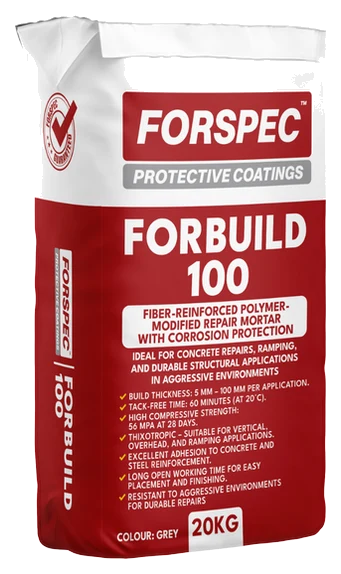
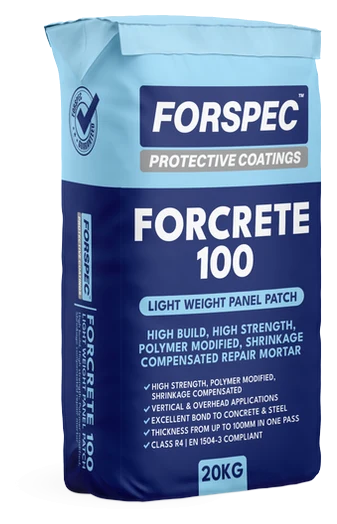
After full reaction, remove the packers and patch the holes flush with FORBUILD 100 or FORCRETE 100.
- 06
Clean
Flush the pump and lines with urethane thinner straight after use. If mixed resin stood for over 20–30 minutes, flush with cleaning alcohol before restarting.
A short guide from the data sheet. Read the full ACTFLEX PU300 TDS before you start.
How much ACTFLEX PU300 do I need?
Polyurethane injection resin for leaking cracks
Crack volume = length × width × depth. The PU data sheets give no fixed rate per metre: estimate from the crack volume plus an allowance for porous zones, then check it on the first section. Packers every 200 mm, the most the TDS allows. Your pump also needs its own charge of resin to prime.
You need
0 packs
Where the figures come from
Crack volume = length × width × depth. The PU data sheets give no fixed rate per metre: estimate from the crack volume plus an allowance for porous zones, then check it on the first section. Packers every 200 mm, the most the TDS allows. Your pump also needs its own charge of resin to prime.
- Consumption: no fixed rate per metre: crack volume plus an allowance, confirmed by trial injection. TDS-PU200, R3, 12 Nov 2026, page 3
- Density at 25°C: 1.12 to 1.20 g/cm³. TDS-PU200, R3, 12 Nov 2026, page 2
- Packer spacing: 10 mm holes at maximum 200 mm intervals. TDS-PU200, R3, 12 Nov 2026, page 3
- Packs: 20 kg counted for all three resins. FORSPEC system figure
ACTFLEX PU300 questions
How do I change the reaction speed?
Change the accelerator dose. At 25°C, 2:1 resin to accelerator reacts in 150 to 200 seconds, and the standard 10:1 in 340 to 360 seconds (typical values).
How long do I have after mixing?
Pot life is 20 to 30 minutes at 25°C and 50% RH. Mix only the quantity you can inject within that time.
Does it need water to foam?
Yes. In dry cracks, inject clean water through the packers before the resin. In very low water content and low counter-pressure the material will expand as a foam.
What is the difference from ACTFLEX PU200?
PU300 is two-component, so you adjust reaction time with the accelerator. The TDS gives ACTFLEX PU200 as the single-component alternative.
How much resin do I need?
There is no fixed rate per metre. Estimate crack volume plus an allowance for porous zones and expansion, and confirm by trial injection on the first section.
Is it for structural repair?
No. It is a water-stopping and void-filling resin. For load-transferring crack repair use the FORSPEC structural injection range.
Used with ACTFLEX PU300
ACTFLEX PU300 TDS and SDS
Always work from the current data sheet. Every FORSPEC TDS and SDS →
Specify it. Or buy it.
Send the drawings or photos and FORSPEC comes back with the system, the details and the quantities. Or find a FORSPEC stockist for ACTFLEX PU300.