
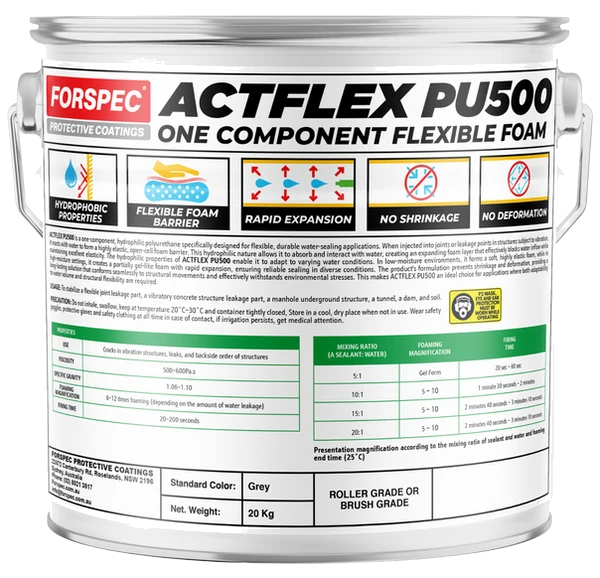
ACTFLEX PU500 PU injection resin
One-component hydrophilic polyurethane injection resin
Flexible hydrophilic PU resin for leaking joints and cracks that move, as gel or soft foam.
ACTFLEX PU500 sizes and key figures
One-component hydrophilic polyurethane resin for sealing leaks in expansion and construction joints and cracks subject to movement and vibration. It reacts with water into an elastic gel or a flexible foam.
- Viscosity
- 500–600 mPa·stypicalat 25°C · TDS p2
- Bond strength
- > 1.18 MPatypicalto concrete · TDS p2
- Elongation
- > 130%typicalthick sections; > 110% in thin sections · TDS p2
- Gel reaction
- 20–60 stypicalelastic gel at 5 : 1 water to resin, 25°C · TDS p2
- Foam reaction
- ≈ 120–300 stypicalfoam, 6–12 times, at 10 : 1 to 20 : 1 water to resin · TDS p2
- Full reaction
- 24 hourstypicalstable seal · TDS p4
- Hole spacing
- ≤ 200 mm10 mm holes at 45°, 60–100 mm deep · TDS p3
- Apply at
- Above 10°Csubstrate and material · TDS p2
- Pack
- 20 kgpail, injected neat with no mixing · TDS p2
From the FORSPEC data sheet, TDS-PU500 · Revision 3 · 12 November 2026. Times are at 25°C and 50% relative humidity unless the data sheet says otherwise. Typical = FORSPEC’s own typical value, not a laboratory-certified one.
Where ACTFLEX PU500 is used
Use it for
- Leaks in expansion and construction joints
- Dynamic cracks subject to movement and vibration
- Tunnels, basements, retaining walls and diaphragm walls
- Segmental tunnel linings
- Reservoirs, wastewater structures and dams
- Precast elements and joints in fluctuating moisture
Know before you start
- Best for permanently damp or wetted areas: may shrink under wet/dry cycling
- Not a structural repair, and not a substitute for an engineered movement joint
- Not below 10°C. Not UV stable. Static dry cracks: use PU200 or PU300
- Not for potable water: do not use in drinking-water tanks or potable water structures
Its FORSPEC systems
How to apply ACTFLEX PU500
- 01
Drill
Drill 10 mm holes at maximum 200 mm intervals, offset from the crack and angled at 45° to meet it at 60 to 100 mm deep. Alternate sides where access allows.
- 02
Packers
Blow or vacuum out the dust. Insert 10 mm non-return packers leaving about 20 mm showing, and tighten each firmly with a T-handle wrench.
- 03
Pre-wet
In dry joints and cracks, inject clean water through the packers first. Keep pump and lines free of water.
- 04
Inject
Inject neat from the pail, no mixing. Start at low pressure. Vertical: bottom packer upward. Horizontal: ends toward the centre. Move on when resin shows about 100 mm either side.
- 05
Finish
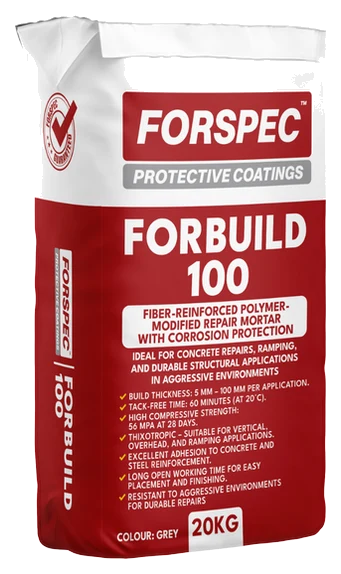
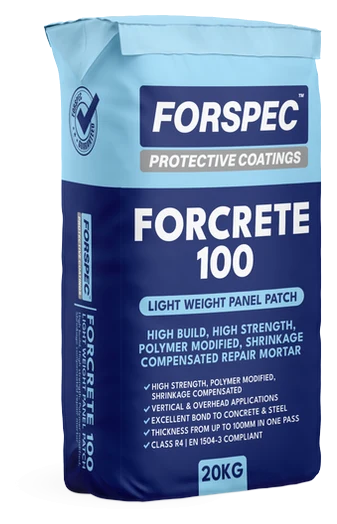
After full reaction, remove the packers and patch the holes flush with FORBUILD 100 or FORCRETE 100.
- 06
Clean
Flush the pump and lines with urethane thinner straight after use, then pump cleaning oil for short-term reuse.
A short guide from the data sheet. Read the full ACTFLEX PU500 TDS before you start.
How much ACTFLEX PU500 do I need?
Polyurethane injection resin for leaking cracks
Crack volume = length × width × depth. The PU data sheets give no fixed rate per metre: estimate from the crack volume plus an allowance for porous zones, then check it on the first section. Packers every 200 mm, the most the TDS allows. Your pump also needs its own charge of resin to prime.
You need
0 packs
Where the figures come from
Crack volume = length × width × depth. The PU data sheets give no fixed rate per metre: estimate from the crack volume plus an allowance for porous zones, then check it on the first section. Packers every 200 mm, the most the TDS allows. Your pump also needs its own charge of resin to prime.
- Consumption: no fixed rate per metre: crack volume plus an allowance, confirmed by trial injection. TDS-PU200, R3, 12 Nov 2026, page 3
- Density at 25°C: 1.12 to 1.20 g/cm³. TDS-PU200, R3, 12 Nov 2026, page 2
- Packer spacing: 10 mm holes at maximum 200 mm intervals. TDS-PU200, R3, 12 Nov 2026, page 3
- Packs: 20 kg counted for all three resins. FORSPEC system figure
Drawings for the systems it goes in
FORSPEC standard details as PDF and DXF. Each sheet is a generic detail: the specification names the products.
ACTFLEX PU500 questions
Does ACTFLEX PU500 form a gel or a foam?
It depends on the water it meets. At 5:1 water to resin it forms an elastic gel in 20 to 60 seconds. At 10:1, 15:1 and 20:1 it forms a flexible foam, 6 to 12 times, in about 120 to 300 seconds (typical, 25°C).
Is it good for joints that move?
Yes. It stays highly elastic and suits joints and cracks with movement and vibration. For large movement you still need a purpose-designed movement joint system.
What if the joint is dry?
It needs water to react. Inject clean water through the packers before the resin. It is best in permanently damp or regularly wetted conditions.
Should I use PU500 or PU200 or PU300?
For static, dry cracks the TDS says ACTFLEX PU200 or PU300 is the better choice. PU500 is for flexible sealing where movement is expected.
How much resin do I need?
There is no fixed rate per metre. Estimate crack volume plus an allowance for porous zones and expansion, and confirm by trial injection on the first section.
Can it do structural repair?
No. It is a flexible water-sealing resin. For load-transferring repair use PROBOND 1100, CRACK PRO 1200PS or CRACKLOCK E400L.
Used with ACTFLEX PU500
ACTFLEX PU500 TDS and SDS
Always work from the current data sheet. Every FORSPEC TDS and SDS →
Specify it. Or buy it.
Send the drawings or photos and FORSPEC comes back with the system, the details and the quantities. Or find a FORSPEC stockist for ACTFLEX PU500.