
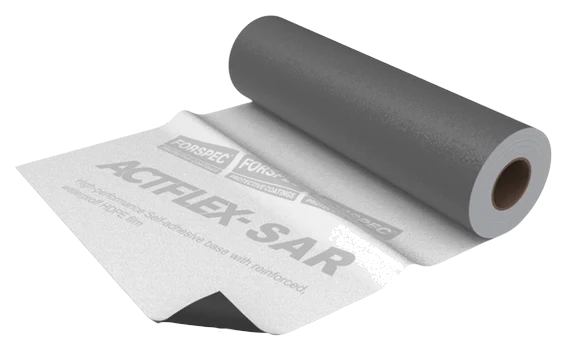
ACTFLEX SAR Self-adhesive sheet
Self-adhesive fibre-reinforced butyl rubber sheet waterproofing membrane
Peel-and-stick butyl sheet. Seals on contact with no cure period, no heat and no torch.
ACTFLEX SAR coverage, coats and cure times
Self-adhesive butyl rubber sheet with a non-woven facing, laid cold onto a primed substrate. For internal wet areas and external balconies, decks and podiums, always covered by tile, screed or topping.
- Thickness
- 1.5 mmtypicalnominal, butyl base with non-woven facing · TDS p3
- Roll size
- 1 m × 10 m10 m² gross; 500 mm width also supplied · TDS p4
- Coverage
- 9.5 m²effective per roll at 50 mm lap; 9.0 m² at 100 mm · TDS p7
- Apply at
- 10–35°Ctypicalambient and substrate · TDS p3
- Cure time
- No cureinstant seal on application · TDS p3
- Foot traffic
- Immediateonce the sheet is fully rolled down · TDS p7
- Flood test
- 24 hours50 mm minimum depth, after all detailing is complete · TDS p7
- Class
- Class IIItypicalhigh extensibility, designed to conform · TDS p3
- Peel adhesion
- ≥ 1.5 N/mmtypicalto primed concrete · TDS p3
From the FORSPEC data sheet, TDS-SAR · Revision 1 · 25 August 2026. Times are at 25°C and 50% relative humidity unless the data sheet says otherwise. Typical = FORSPEC’s own typical value, not a laboratory-certified one.
Where ACTFLEX SAR is used
Use it for
- Internal wet areas: bathrooms, laundries and ensuites
- Balconies, decks, podiums and terraces, floors, walls and upstands
- Walls, upstands and floor-to-wall transitions
- Metal, glazed, stone and plastic substrates where liquids don't suit
- Overcoating sound existing epoxy coatings
- Hybrid systems with the FORSPEC liquid membrane range
Know before you start
- Always prime: never lay onto an unprimed surface
- Not on damp substrates, or over particleboard, chipboard or platform flooring
- Not a wearing surface and not UV stable: cover as soon as practicable
- Not for permanent immersion: pools, tanks and ponds need written FORSPEC confirmation
How to apply ACTFLEX SAR
- 01
Prepare
Clean, smooth and dry. Concrete cured 28 days, render and screed 7 days. Fill voids and pitted sections with PROBOND 1100 or FORSPEC repair mortar first.
- 02
Prime
ACTFLEX EP250 on porous substrates (two coats if moisture is high). ACTFLEX 500 NP PRIMER on metals, glazed surfaces, stone, rigid plastics and epoxy. Never skip it.
- 03
Cracks and joints
Treat cracks before laying. Never lay continuous sheet across a movement joint: use ACTFLEX MS PRO over a bond breaker and end the sheet each side.
- 04
Lay
Dry-position the cut length, then peel the liner back progressively. Work outward from the centre with a roller, trowel or float to remove air. Do not stretch it.
- 05
Detail
Carry the sheet 150 mm minimum above finished floor level at perimeters. Use the liquid membrane range at corners and penetrations, lapped 50 mm onto the sheet.
- 06
Test and cover
Roll every lap. Flood test 50 mm deep for 24 hours, then tile, screed or topping. Cover soon: it is not for permanent exposure.
A short guide from the data sheet. Read the full ACTFLEX SAR TDS before you start.
ACTFLEX SAR test reports and compliance
- AS/NZS 4858:2004
- Designed to comply as Class III, testing in progressForspec R&D, not certified
- AS 4654.1-2012
- Designed to comply as Class III, testing in progressForspec R&D, not certified
- AS 3740:2021
- Suitable as part of a complete FORSPEC systemForspec R&D
- VOC content
- Solvent-free, no volatile organic solventsForspec R&D
- AS/NZS 4020
- No certification heldWritten FORSPEC confirmation needed
Results as stated in the data sheet, TDS-SAR · Revision 1 · 25 August 2026. Warranty up to 25 years, depending on the system: ask FORSPEC which term applies to your system.
ACTFLEX SAR questions
Do I need a primer under ACTFLEX SAR?
Yes, on every substrate without exception. Use ACTFLEX EP250 on concrete, render, screed, fibre cement and plywood. Use ACTFLEX 500 NP PRIMER on metals, glazed surfaces, stone, plastics and epoxy.
How long does it take to cure?
There is no cure period. It seals instantly on application and takes light foot traffic as soon as it is fully rolled down. Flood test after detailing is done, then tile or screed.
How much ACTFLEX SAR do I need?
A roll is 1 m × 10 m, 10 m² gross. Effective area is 9.5 m² at a 50 mm lap or 9.0 m² at 100 mm. Allow at least 10% extra for end laps, upstands and cutting waste.
Can it go on a damp slab?
No. Damp, wet or green substrates are not approved because a self-adhesive membrane will not bond to a damp surface. If readings exceed 80% RH, apply at least two coats of EP250 first.
What can it stick to?
Concrete, render, screed, fibre cement, plywood, metals, glazed surfaces, marble, granite, plastics and sound existing epoxy. Plastics and epoxy need an adhesion test area first.
Can it be left exposed?
No. It is not a wearing surface and not UV stable for permanent exposure. Cover it with tile, screed, topping or an approved finish as soon as practicable.
Used with ACTFLEX SAR
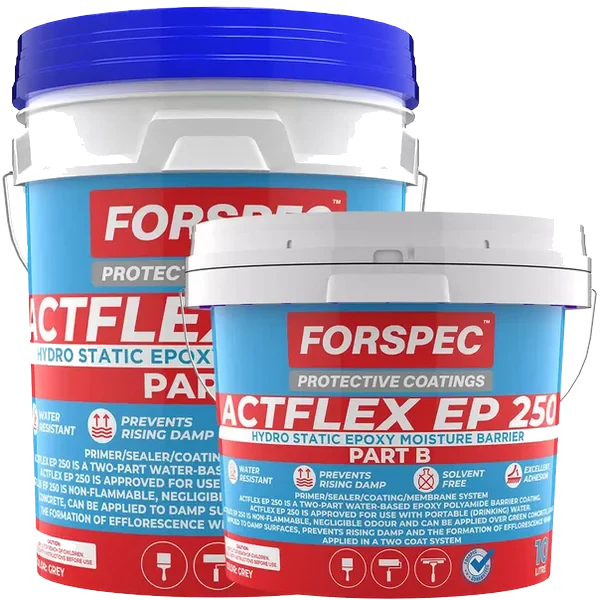
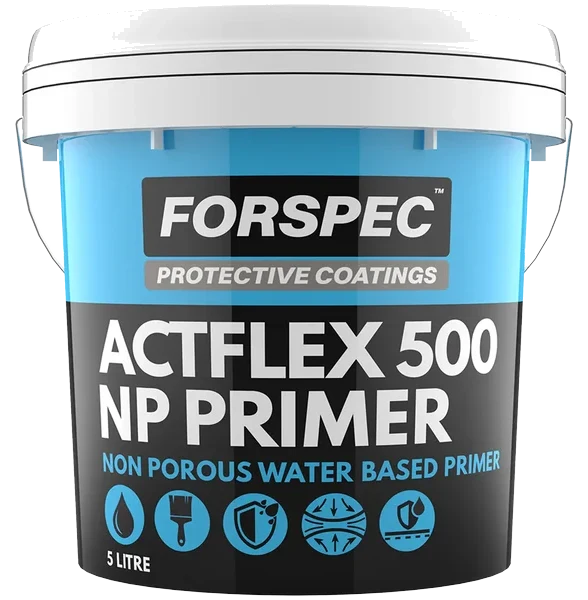
ACTFLEX SAR data sheet
Always work from the current data sheet. Every FORSPEC TDS and SDS →
Specify it. Or buy it.
Send the drawings or photos and FORSPEC comes back with the system, the details and the quantities. Or find a FORSPEC stockist for ACTFLEX SAR.