
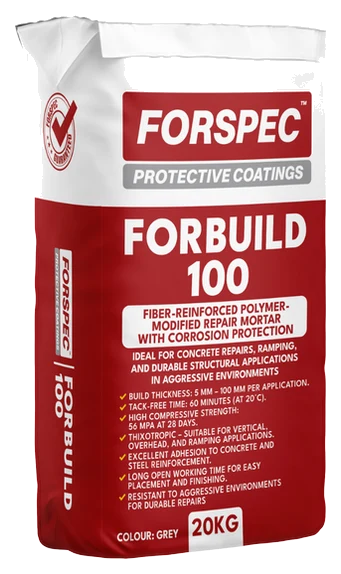
FORBUILD 100 Repair mortar
Fibre-reinforced, polymer-modified structural repair mortar
Structural repair mortar with corrosion inhibitors. 56 MPa at 28 days, mix with water only.
FORBUILD 100 coverage, coats and cure times
Single-component, fibre-reinforced, polymer and microsilica modified repair mortar with corrosion inhibitors, for reinforced concrete in aggressive environments. Place by hand or wet-spray without formwork.
- Compressive
- 56 MPatypicalat 28 days, EN 12190 · TDS p2
- Adhesion
- 2.34 MPatypicalto concrete, EN 1542 · TDS p2
- Flexural
- 10.3 MPatypicalat 28 days; 6.8 MPa at 7 days · TDS p2
- Pot life
- 60 minat 25°C and 50% RH · TDS p2
- Set
- 75 / 120 mininitial / final set · TDS p2
- Build
- 3–100 mmhorizontal, per layer. Vertical: up to 40 mm per pass · TDS p2
- Water
- 3.2–3.4 Lper 20 kg bag (16% ± 1%) · TDS p2
- Coverage
- ≈ 1.1 m²per 20 kg bag at 10 mm; 1.85 kg/m² per mm · TDS p3
- Pack
- 20 kg baggrey powder, about 11 L of mortar · TDS p2
From the FORSPEC data sheet, TDS-FORBUILD100 · Revision 2 · 12 August 2026. Times are at 25°C and 50% relative humidity unless the data sheet says otherwise. Typical = FORSPEC’s own typical value, not a laboratory-certified one.
Where FORBUILD 100 is used
Use it for
- Corroded-reinforcement repairs: marine, bridges, harbours, dams
- Repair of carbonated concrete, restoring alkalinity around steel
- Concrete exposed to de-icing salts, freeze/thaw and chloride attack
- Vertical, horizontal and overhead patches, ramping, falls correction
- Edge rebuilding and protective layers
- Water-retaining structures: tanks, canals, culverts, treatment plants
Know before you start
- Not over bituminous coatings, weak or friable substrates, or active rising damp
- Never add cement, lime, gypsum or other additives, or exceed the mixing water
- No curing compounds: cure by water misting or coverings only
- Not below 5°C or above 35°C; steel needs at least 10 mm of mortar cover
Its FORSPEC systems
How to apply FORBUILD 100
- 01
Prepare
Remove all damaged and loose concrete and cut edges square, at least 5 mm deep, never feathered. Clean exposed steel to bright metal. Dampen to saturated surface dry with no free water.
- 02
Prime
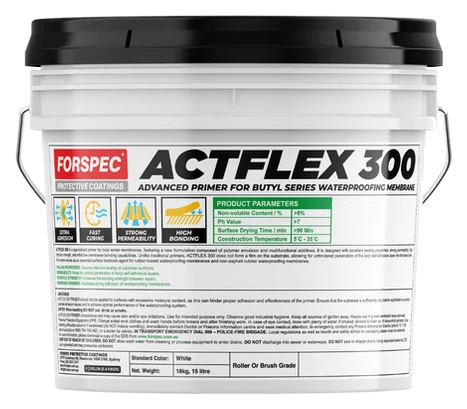
Prime with ACTFLEX 300 by brush or roller. For best adhesion add a slurry coat of 1 part ACTFLEX 300, 1 part water and 3 parts FORBUILD 100, rest 10 minutes, and place the mortar while tacky.
- 03
Mix
Water first, 3.2 to 3.4 L per 20 kg bag, then add powder slowly. Mix at 400–600 rpm for 3 to 4 minutes, rest 1 to 2 minutes, re-mix briefly. Use within 60 minutes.
- 04
Apply
Horizontal: spread and compact, 3 to 100 mm per layer. Vertical and overhead: trowel or wet-spray in passes up to 40 mm, to 100 mm total, compacting around the steel.
- 05
Cure
Mist with water for at least 1 hour after finishing. Above 30°C and below 50% humidity, cover with damp hessian or plastic for 24 hours. Keep curing for at least 48 hours.
- 06
Overcoat
Overcoat with FORSPEC membranes and coatings after a minimum of 7 days, once moisture is verified.
A short guide from the data sheet. Read the full FORBUILD 100 TDS before you start.
How much FORBUILD 100 do I need?
Structural repair mortar, 20 kg bag
Area × thickness is the volume to fill; one pack makes the litres shown on the data sheet. The sheet's coverage is theoretical: rough surfaces use more.
You need
0 bags
An estimate from the data sheet figures. Check it before you order.
Where the figures come from
Area × thickness is the volume to fill; one pack makes the litres shown on the data sheet. The sheet's coverage is theoretical: rough surfaces use more.
- One 20 kg bag makes: about 11 litres of mortar. TDS-FORBUILD100, R2, 12 Aug 2026, page 3
- Powder: 1.85 kg per m² per mm. TDS-FORBUILD100, R2, 12 Aug 2026, page 2
- Thickness: 3 to 100 mm a layer on the flat; 40 mm a pass on walls and soffits. TDS-FORBUILD100, R2, 12 Aug 2026, page 2
Drawings for the systems it goes in
FORSPEC standard details as PDF and DXF. Each sheet is a generic detail: the specification names the products.
FORBUILD 100 test reports and compliance
- EN 1504-3
- Mortar of the type covered by Part 3; full classification testing on requestForspec R&D data, no report cited
- EN 12190 compressive
- 56 MPa at 28 daysForspec R&D typical, no report cited
- EN 1542 adhesion
- 2.34 MPaForspec R&D typical, no report cited
- EN 13412 modulus
- 30 GPaForspec R&D typical, no report cited
- EN 1015-11 flexural
- 10.3 MPa at 28 daysForspec R&D typical, no report cited
Results as stated in the data sheet, TDS-FORBUILD100 · Revision 2 · 12 August 2026. Warranty up to 25 years, depending on the system: ask FORSPEC which term applies to your system.
FORBUILD 100 questions
How much FORBUILD 100 do I need?
1.85 kg of powder per m² per mm of thickness. A 10 mm repair over 1 m² needs about 18.5 kg, roughly one 20 kg bag. One bag mixed with 3.2 to 3.4 L of water yields about 11 litres.
Do I need a primer?
Yes. Prime with ACTFLEX 300 and place the mortar while the primer is tacky. For maximum adhesion, brush on the slurry bonding coat first.
How thick can I apply it?
Horizontal: 3 to 100 mm per layer. Vertical and overhead: up to 40 mm per pass, to 100 mm total. Build deeper repairs in layers with curing between.
How long before I can overcoat it?
A minimum of 7 days, with moisture verified, before FORSPEC membranes and coatings (typical). Light foot traffic is possible at 24 hours.
Can I use a curing compound?
No. Cure by water misting or protective coverings only, for a minimum of 48 hours.
How much water do I add?
3.2 to 3.4 L per 20 kg bag, and never more. For spray or pump use, up to 3.6 L may be used. Never re-temper stiffened mortar.
Used with FORBUILD 100
FORBUILD 100 TDS and SDS
Always work from the current data sheet. Every FORSPEC TDS and SDS →
Specify it. Or buy it.
Send the drawings or photos and FORSPEC comes back with the system, the details and the quantities. Or find a FORSPEC stockist for FORBUILD 100.