
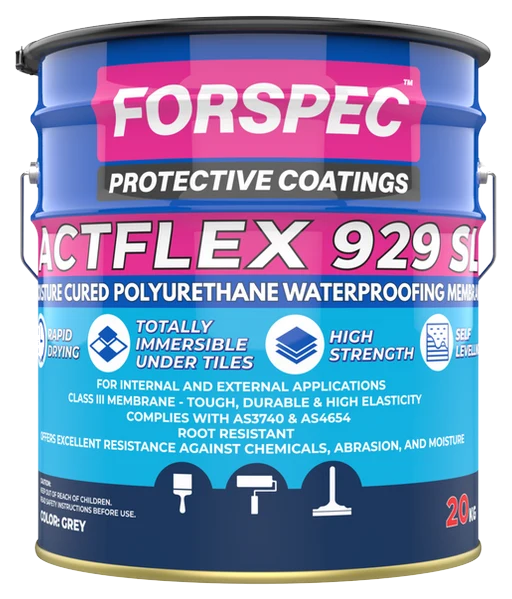
ACTFLEX 929 SL Self-levelling membrane
One-component moisture-cured self-levelling polyurethane waterproofing membrane
Pour-and-level Class III membrane for horizontal work beneath screeds, tiles and toppings.
How ACTFLEX 929 SL goes on
ACTFLEX 929 SL coverage, coats and cure times
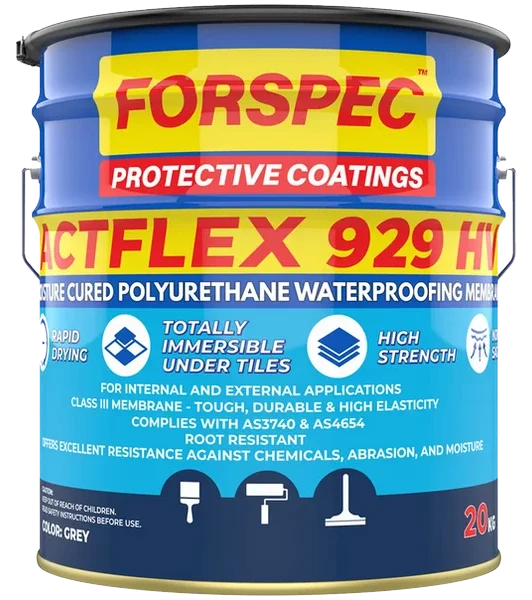
One-component self-levelling polyurethane membrane for floors, balconies, terraces, podiums and planter boxes beneath screeds, tiles or pavers. Use ACTFLEX 929 HV for walls and upstands.
- Coverage
- 8–10 m²practical, per 15 L pail at 1.2 mm DFT · TDS p6
- Dry film
- 1.2 mmminimum, 2 coats at 0.7 mm wet each · TDS p6
- Planter box
- 1.5 mmminimum, 2 coats at about 0.85 mm wet · TDS p6
- Recoat
- 24–48 hminimum 24 hours, maximum 48 hours · TDS p7
- Tack-free
- 12 hin a ventilated area, at 1.2 mm DFT · TDS p7
- Full cure
- 48 hbefore tiling, screeding, flood test or covering · TDS p7
- Flood test
- After cure24-hour test, 50 mm minimum depth · TDS p7
- Pack
- 15 L pail20 kg, grey · TDS p3
- Apply at
- 10–30°Csubstrate at least 3°C above dew point · TDS p3
From the FORSPEC data sheet, TDS-929SL · Revision 4 · 27 October 2026. Times are at 25°C and 50% relative humidity unless the data sheet says otherwise.
Where ACTFLEX 929 SL is used
Use it for
- Internal wet areas: bathrooms, showers, laundries and kitchens
- Balconies, terraces, podiums and roofs beneath screeds or tiles
- Planter boxes and above-ground pits, 1.5 mm total DFT
- Foundations, ground floors and suspended slabs, positive side
- Covered bridges, walkways, substations and parking decks
- Industrial and warehouse floors beneath protective toppings
Know before you start
- Horizontal only: it slumps on walls, so use ACTFLEX 929 HV for upstands
- Not UV stable: cover it, or topcoat with ACTFLEX ATC or ULTRA TC
- Not for pools, ponds, chlorine, silicone or bituminous surfaces
- No direct tiling, and light maintenance foot traffic only
Its FORSPEC systems
How to apply ACTFLEX 929 SL
- 01
Prepare
Concrete cured 28 days, CSP 2–4, wood-trowel finish. Renders and screeds 7 days. Falls at least 1:80 indoors and 1:100 outdoors. Plug drains first.
- 02
Prime
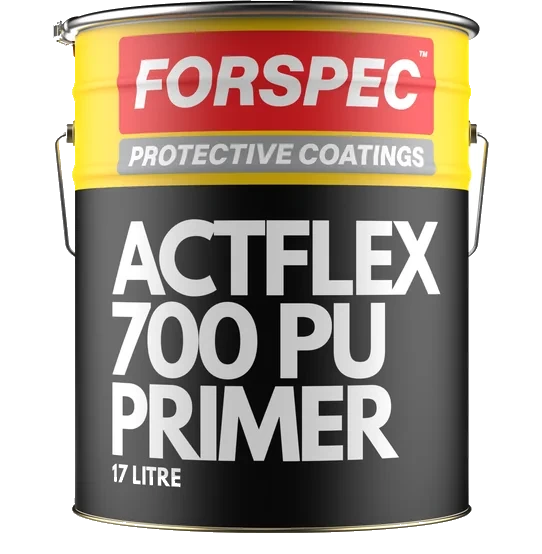
Priming is mandatory. ACTFLEX 700 PU PRIMER on porous dry substrates, two coats of ACTFLEX EP250 on damp or high-moisture ones, ACTFLEX SUPERBOND 007 on non-porous surfaces.
- 03
Detail
Cracks under 2 mm: ACTFLEX SA TAPE, lapped 50 mm. Cracks 2 mm and over: ACTFLEX 75FC in a 6 x 6 mm reglet. Fillet junctions: 12 mm indoors, 15 x 15 mm outdoors.
- 04
Mix
One part, no ratio. Cut out any skin. Mix with a drill at 300–500 RPM for 2 to 3 minutes. Do not dilute. Use the full pail once opened.
- 05
Apply
Pour, spread by squeegee or roller and back-roll. Two coats at 0.7 mm wet for 1.2 mm DFT, never over 1.5 mm wet in one coat. Recoat after 24 hours, within 48.
- 06
Cover
After 48 hours cure, flood test for 24 hours. Then lay a slip sheet, screed 40 mm minimum (35 mm with SCREED X) and tile to the screed.
A short guide from the data sheet. Read the full ACTFLEX 929 SL TDS before you start.
How much ACTFLEX 929 SL do I need?
Self-levelling polyurethane membrane, 15 L pail
Two coats at 0.7 mm wet = 1.4 L/m² for 1.2 mm dry (planter boxes 2 × 0.85 mm = 1.7 L/m², 1.5 mm dry). A 15 L pail covers 10.7 m² in theory and 8 to 10 m² in practice: the 20% allowance lands at about 8.9 m². Primer: 700 PU one coat (17 L, about 68 m²); damp, EP 250 two coats (4 kg kit, about 6.25 m²); metal or PVC, SUPERBOND 007 (1 L, about 8 m², or 250 ml, about 2 m²). 75FC 15 × 15 mm fillet around the edge: about 5.3 m per 600 mL.
You need
0 pails
Where the figures come from
Two coats at 0.7 mm wet = 1.4 L/m² for 1.2 mm dry (planter boxes 2 × 0.85 mm = 1.7 L/m², 1.5 mm dry). A 15 L pail covers 10.7 m² in theory and 8 to 10 m² in practice: the 20% allowance lands at about 8.9 m². Primer: 700 PU one coat (17 L, about 68 m²); damp, EP 250 two coats (4 kg kit, about 6.25 m²); metal or PVC, SUPERBOND 007 (1 L, about 8 m², or 250 ml, about 2 m²). 75FC 15 × 15 mm fillet around the edge: about 5.3 m per 600 mL.
- Total consumption, two coats: 1.4 L/m² (planter boxes 1.7 L/m²). TDS-929SL, R4, 27 Oct 2026, page 6
- 15 L pail: theoretical; practical: 10.7 m²; 8 to 10 m². TDS-929SL, R4, 27 Oct 2026, page 6
- EP 250 two coats: 0.64 kg/m² (4 kg kit about 6.3 m²). TDS-EP250, R4, 12 Nov 2026, page 3
- 700 PU coverage: 4 to 6 m²/L per coat. TDS-700PU, R2, 12 Aug 2026, page 2
- SUPERBOND 007 on dense substrates; pack: 8 to 12 m²/L (8 used); 1000 mL. TDS-SUPERBOND007, R1, 25 Aug 2026, page 2
- 75FC demand: width × depth in mm = mL per metre. TDS-75FC, R2, 12 Aug 2026, page 3
- SUPERBOND 007 packs shown: 1 L and 250 ml. FORSPEC system figure
More: ACTFLEX 929 SL product page · Balconies & podiums system
Where it has been used
FORSPEC projects built with ACTFLEX 929 SL.
Drawings for the systems it goes in
FORSPEC standard details as PDF and DXF. Each sheet is a generic detail: the specification names the products.
ACTFLEX 929 SL test reports and compliance
- AS/NZS 4858:2004 (R2020)
- Class III, all durability and cyclic-movement criteria passReport No. 429-2
- AS 3740:2021
- Satisfies membrane requirements via AS/NZS 4858 Class IIIReport No. 429-2
- AS 4654.1-2012
- Complies, Class IIIReport No. 429-3
Download the reports
Results as stated in the data sheet, TDS-929SL · Revision 4 · 27 October 2026. Warranty up to 25 years, depending on the system: ask FORSPEC which term applies to your system.
ACTFLEX 929 SL questions
Can I tile straight onto ACTFLEX 929 SL?
No. Do not tile directly to the membrane. Lay a 200-micron slip sheet, install an unbonded screed over the cured, flood-tested membrane, and fix tiles to the screed to AS 3958.1.
How much ACTFLEX 929 SL do I need?
One 15 L pail covers 8 to 10 m² in practice at 1.2 mm in two coats (10.7 m² in theory). Planter boxes at 1.5 mm use about 1.7 L/m², or 8.8 m² per pail in theory.
Can I use 929 SL on walls?
No. It is self-levelling and will slump on vertical surfaces. Use ACTFLEX 929 HV for walls and upstands.
Do I need a primer?
Yes, on all substrates. Use ACTFLEX 700 PU PRIMER on porous dry surfaces, two coats of ACTFLEX EP250 on damp or high-moisture ones, and ACTFLEX SUPERBOND 007 on non-porous surfaces.
How long before I can flood test or screed?
Allow 48 hours full cure after the final coat. Then flood test for 24 hours at 50 mm minimum depth before screeding or covering.
Can it be left exposed?
No. It is not UV stable. Cover it after curing, or topcoat with ACTFLEX ATC or ACTFLEX ULTRA TC where exposure is unavoidable.
Used with ACTFLEX 929 SL
ACTFLEX 929 SL TDS and SDS
Show all 6 documents ↓
Always work from the current data sheet. Every FORSPEC TDS and SDS →
Specify it. Or buy it.
Send the drawings or photos and FORSPEC comes back with the system, the details and the quantities. Or find a FORSPEC stockist for ACTFLEX 929 SL.