
Waterproofing standards in Australia. Which one applies where.
·4 min read·FORSPEC Technical Team
The short version
- Wet areas inside homes: AS 3740. Balconies, roofs and other areas outside, above ground: AS 4654 Parts 1 and 2.
- A membrane's own tests and class come from AS/NZS 4858 inside and AS 4654.1 outside. Tiles over it bring in AS ISO 13007.
- The NCC puts AS 3740, AS 4654 and AS/NZS 4858 on a job, and in places asks for more than the standard does.
Ask which standard applies to a waterproofing job and the honest answer is usually two or three at once. The building code decides which rules the job has to meet. The standards it calls up fill in the detail. Here is which one covers what.
The map
- AS 3740
- Wet areas inside homes, such as showers and bathrooms. How the membrane is designed and installed.
- AS 4654.1
- Membranes outside, above ground: the membrane material and the tests it passes.
- AS 4654.2
- Membranes outside, above ground: design and installation on balconies, roofs and podiums.
- AS/NZS 4858
- Wet-area membranes: the tests the membrane passes on its own, and its class (I, II or III).
- AS ISO 13007
- Tile adhesives (codes such as C2 S1) and membranes tested with tiles bonded on. Called up by the tiling standard, AS 3958.
- NCC
- The building code. It calls up AS 3740, AS 4654 and AS/NZS 4858, says where waterproofing goes, and adds rules of its own.
Inside: AS 3740
AS 3740:2021 covers wet areas inside homes: falls under the membrane, upturns, waterstops, bond breakers and how the membrane meets the floor waste. For houses, the NCC accepts it as one of two routes. For apartments, the NCC asks for AS 3740 together with its own Specification 26.
Building to AS 3740 does not switch off the NCC's own rules. The NCC still says which parts of the room are waterproof, and it sets its own falls for a floor with a floor waste: see bathroom falls: 1:100 or 1:80. The rules most often missed are in AS 3740 in plain English.
Outside: AS 4654 Parts 1 and 2
Balconies, roofs and other areas outside and above ground come under AS 4654. Part 1 is the membrane: what it is and the tests it passes, for an exposed or a covered membrane. Part 2 is the job: falls, fillets, upturns, terminations, outlets and what goes on top. Both are 2012 editions, and NCC 2025 still calls up those editions. More on both parts: AS 4654 Parts 1 and 2.
AS 4654 stops at ground level. No Australian Standard covers basements or tanking below ground: see is there a basement waterproofing standard?
The membrane's own rating: AS/NZS 4858
AS/NZS 4858 tests a wet-area membrane on its own: water, vapour, bleach and detergent, movement and heat. It also gives the membrane a class by how far it stretches before it breaks: Class I 10 to 59%, Class II 60 to 299%, Class III 300% or more. The class sets how wide the bond breaker has to be at a joint.
It says nothing about tiles sticking to the membrane. That is the next standard's job: see Class III and C2 S1 are not the same kind of rating.
Tiles over the membrane: AS ISO 13007
The 13007 family covers what goes on top. Part 1 gives tile adhesives their codes: C for cement-based, 2 for improved, S1 for deformable, T for slip resistance on a wall, E for extended open time. Part 5 tests a liquid membrane with tiles bonded to it, and AS 13007.6 does the same for a sheet membrane.
The tiling standard, AS 3958, ties them together: a membrane under tiles has to meet AS/NZS 4858 inside or AS 4654.1 outside, plus the 13007 test for its type, and the tile adhesive has to be tested for compatibility with that membrane before use.
The NCC: what puts a standard on the job
A standard on its own is just a document until something calls it up: a contract, a specification or the NCC. The NCC calls up AS 3740, AS 4654 and AS/NZS 4858 as deemed-to-satisfy routes, and the work is checked against them. The 13007 tests come in through the tiling standard, AS 3958. Only the certifier or building surveyor decides whether a job is acceptable.
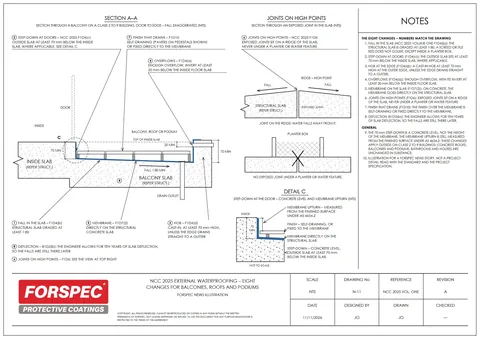
NCC 2025 added new rules for concrete balconies, roofs and podiums on apartment and commercial buildings. Wet areas inside are unchanged in substance. When it starts depends on the state: the dates and the detail are in NCC 2025 waterproofing changes.
Where this comes from
- AS 3740:2021
- AS 4654.1-2012
- AS 4654.2-2012: 1.1
- AS/NZS 4858:2004: 5, 6, 8
- AS ISO 13007.1:2020: 4
- AS ISO 13007.5:2020: 4
- AS 13007.6:2022: 4
- AS 3958:2023: 2.14
- NCC 2025
Standards are summarised in FORSPEC's own words as a guide. Read the standard itself and your project documents before you build.
General information, correct at the date shown. Not advice for your job.
Systems, products and drawings
Got a job this applies to?
Send the drawings or a few photos. FORSPEC comes back with the system, the details and the products for your job, within 6 business hours.
On site with FORSPEC
@forspec.pc on Instagram →
 ▶ 3.2K
More news
All news →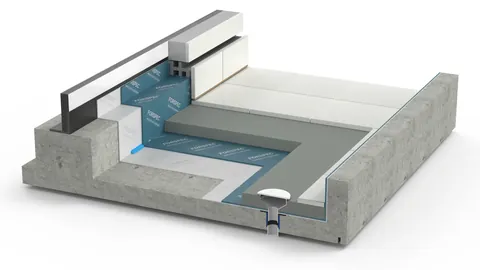
The month in waterproofing. In one email.
Code and standards changes, new products, new test reports and jobs from site. Once a month. No sales emails.